
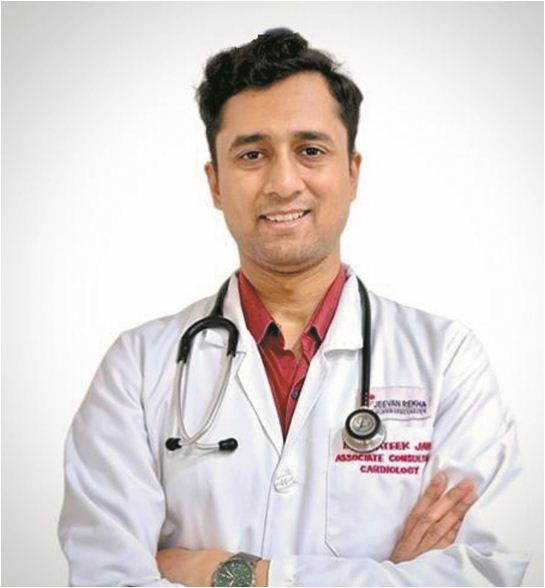
Charu Bhatia, Senior News Editor, Business Remedies, in conversation with Dr. Prateek Jain, Consultant Interventional Cardiologist from Jeevan Rekha Superspeciality and Multispeciality Hospital, Jaipur
With heart diseases increasingly affecting younger individuals and lifestyle-related risk factors on the rise, cardiac care has become more important than ever. From advances in artificial intelligence and imaging technologies to growing awareness gaps among the public, the field of cardiology is witnessing rapid transformation. In this exclusive interview, Dr. Prateek Jain, Consultant Interventional Cardiologist from Jeevan Rekha Superspeciality and Multispeciality Hospital, Jaipur, discusses his professional journey, the future of cardiac medicine, common misconceptions about heart health, and the crucial steps people can take to protect their hearts.
Q. You are a renowned cardiologist practicing at Jeevan Rekha Superspeciality and Multispeciality Hospital, Jaipur. How has your journey been so far?
Answer: It has been an incredible and fulfilling journey. My medical education began with pursuing MBBS from King George’s Medical University, Lucknow, followed by MD in Medicine, following which I completed my DM in Cardiology from SMS Medical College, Jaipur. Looking back, every stage of my professional journey has contributed significantly to shaping me as a cardiologist.
If I speak about my inspiration for entering the medical profession, the biggest influence in my life has been my father, who is himself a physician. Watching his dedication towards patients and his commitment to healthcare inspired me from an early age. Medicine was therefore a natural choice for me.
When it came to selecting a specialization, cardiology attracted me because of its dynamic nature and the challenges associated with it. The heart is one of the most vital organs in the human body, and managing cardiac conditions often requires quick decision-making and precision. The complexity of the specialty fascinated me, and that ultimately motivated me to pursue cardiology as a career.
Q. What were some of the challenges you faced during your medical studies?
Answer: Medical education itself is demanding, but the transition from general medicine to cardiology presented an entirely new set of challenges. During my MD in Medicine, I developed a strong foundation in clinical practice. However, cardiology is a highly specialized field that requires deeper knowledge, technical expertise, and continuous learning.
Another significant challenge was adapting to the rigorous schedule. Medical training often involves long working hours, night duties, emergency responsibilities, and continuous academic commitments. As doctors, we are expected to remain available whenever patients need us. Initially, adjusting to this demanding lifestyle was difficult, but over time, it became a part of professional life.
Q. According to you, what is the role of AI and technology in cardiology?
Answer: Artificial Intelligence and technological advancements are transforming healthcare in remarkable ways. AI has the potential to assist healthcare professionals across multiple areas, ranging from diagnosis to treatment planning and patient monitoring.
In cardiology, AI can play an important role in analyzing patient data, identifying risk factors, and assisting doctors during procedures. It can also contribute to improving the accuracy and efficiency of interventions such as angioplasties.
Technological innovations have significantly improved cardiac care over the past decade. For instance, imaging technologies like Optical Coherence Tomography (OCT) provide detailed visualization of blood vessels, enabling better decision-making during interventions. Compared to what was available ten years ago, the tools and technologies at our disposal today are far more advanced and are contributing to better patient outcomes.
Q. What do you think are the primary challenges when it comes to heart health education?
Answer: One of the biggest challenges is the lack of awareness among the general population regarding heart health. Many individuals ignore early warning signs and delay seeking medical attention. This delay can sometimes prove fatal.
Time is extremely important in cardiac emergencies. In conditions such as heart attacks, every minute counts because delayed treatment can lead to irreversible damage to heart muscles. When patients arrive at the hospital at an advanced stage, our treatment options become limited. On the other hand, if they seek medical help promptly, there is much more that can be done to preserve heart function and save lives.
Therefore, educating people about recognizing symptoms and seeking timely medical care remains a major priority.
Q. What are some early signs that patients should never ignore?
Answer: There are several symptoms that should not be neglected under any circumstances. These include chest pain, chest discomfort during physical exertion, shortness of breath, excessive sweating, breathlessness, palpitations, and unexplained fatigue.
Individuals experiencing any of these symptoms should consult a doctor without delay. Additionally, people must pay attention to conditions such as high blood pressure, diabetes, obesity, and abnormal cholesterol levels. Proper management of these risk factors can significantly reduce the chances of developing heart disease later in life.
Q. What kind of heart problems do patients commonly present with?
Answer: We encounter a wide range of cardiac conditions in clinical practice. Heart attacks remain one of the most common emergencies. Apart from that, patients frequently present with irregular heart rhythms, decreased heart rate, palpitations, episodes of loss of consciousness, congenital heart diseases, and valvular abnormalities.
Many of these conditions can be managed effectively if diagnosed and treated at the appropriate time. This is why regular health check-ups and timely consultation with a cardiologist are so important.
Q. How do you view the doctor-patient relationship in today’s digital age?
Answer: There is no doubt that people today are much more informed about health-related issues than before. Easy access to information through the internet and digital platforms has increased awareness significantly.
However, alongside this increased awareness, there has also been a gradual erosion of trust in the doctor-patient relationship. Patients often arrive with preconceived notions based on online information, which can sometimes create misunderstandings.
As doctors, we must accept this changing reality and continue working with honesty, professionalism, and the right intentions. Ultimately, our responsibility is to provide evidence-based care and guide patients towards the best possible treatment decisions.
Q. What is your opinion on government healthcare schemes? Are they proving beneficial?
Answer: Yes, government healthcare schemes have undoubtedly helped many economically weaker sections of society. These initiatives have made quality healthcare and advanced treatments accessible to people who may otherwise have struggled to afford them.
At the same time, there are instances where individuals who are financially capable of paying for treatment also utilize these schemes. Ideally, there should be well-defined eligibility criteria so that the maximum benefits reach those who genuinely need assistance. Ensuring proper implementation can make these schemes even more effective.
Q. What lifestyle habits are proving dangerous for heart health today?
Answer: One of the most concerning trends today is the increasing incidence of heart disease among younger individuals. Earlier, heart attacks were predominantly associated with older age groups, but now we are seeing cardiac events even among young adults.
Lifestyle changes are a major contributing factor. Modern life has become increasingly stressful, and competition in every sphere has intensified. Chronic stress leads to elevated stress hormone levels, which in turn contribute to obesity, hypertension, diabetes, and other metabolic disorders.
Over time, these factors place tremendous strain on the cardiovascular system and increase the risk of heart disease. Therefore, stress management, physical activity, healthy eating habits, and adequate sleep are extremely important for maintaining heart health.
Q. What are some of the ongoing areas of research in cardiac medicine?
Answer: Research in cardiology is progressing rapidly. Several studies are currently exploring new drugs and treatment approaches for heart failure. Evidence-based medicines continue to evolve, providing better outcomes for patients with complex cardiac conditions.
Researchers are also investigating innovative alternatives and advancements related to heart transplantation and advanced cardiac therapies. Continuous research is essential because it enables doctors to offer safer and more effective treatment options. The future of cardiac medicine looks promising, and ongoing scientific developments will undoubtedly benefit patients in the years ahead.
Q. Which tests are commonly recommended for evaluating heart health?
Answer: An Electrocardiogram (ECG) is one of the most commonly performed cardiac tests. However, people should understand that an ECG captures only a specific moment of heart activity. A normal ECG does not necessarily rule out all heart-related problems.
For a comprehensive evaluation, periodic investigations are important. An echocardiogram provides valuable information about the structure and functioning of the heart. The treadmill test is another important investigation that assesses how the heart performs under physical exertion.
In addition, routine investigations such as Complete Blood Count (CBC), lipid profile, blood sugar tests, and other relevant assessments should be conducted regularly based on individual risk factors and medical advice.
Q. What are some common myths regarding heart health?
Answer: One of the most widespread myths is that a normal ECG means the heart is completely healthy. This is incorrect because an ECG only reflects the heart’s activity at a particular point in time. Many individuals may remain symptom-free for years despite underlying cardiac issues.
Another misconception is that symptoms such as mild breathlessness or occasional discomfort are not serious enough to warrant medical attention. Such assumptions can be dangerous. Clinical judgment is crucial, and only a qualified doctor can determine whether further investigations are required.
There is also a belief that smoking in small quantities does not significantly increase cardiovascular risk. This is false. Even limited smoking is a risk factor for heart disease and can contribute to long-term cardiovascular damage.
Q. Lastly, what message would you like to give to young people who aspire to pursue cardiology?
Answer: Cardiology is an exciting and rewarding field, but it is also one of the most demanding branches of medicine. My advice to aspiring cardiologists is to choose this specialty only if they are genuinely dedicated and committed to it, and not merely because it appears fascinating or prestigious.
Before entering the field, one should understand its challenges, responsibilities, and impact on personal lifestyle. Cardiology requires continuous learning, hard work, resilience, and a strong sense of responsibility towards patients. Those who are passionate about making a difference in people’s lives and are prepared for the demands of the profession will find it to be an immensely satisfying career.