

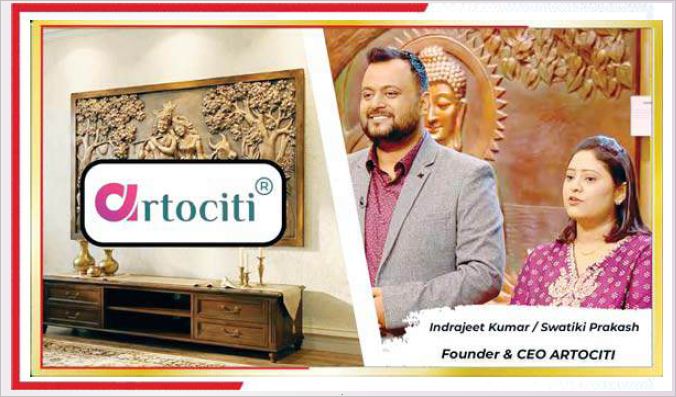
Rajshree Upadhyaya | Business Remedies | The story of Artociti begins in 2021 when Indrajeet Kumar and Swatiki Prakash founded Artociti Canvas Private Limited on January 6 in Bokaro, Jharkhand, with a clear vision to transform the way Indian art is experienced inside contemporary homes. What started as a small creative experiment soon evolved into a fast-growing brand that blended traditional craftsmanship with scalable design, creating a niche in the premium yet accessible home décor segment.
Indrajeet Kumar’s exposure to global décor markets played a significant role in shaping the foundation of the brand. He realized that while India had immense artistic richness, especially in handcrafted and cultural art forms, there was a lack of structured businesses that could turn these into scalable, design-forward products. Along with Swatiki Prakash, the idea was to not just sell art but to build a system where art could be reproduced without losing its originality, making it more accessible to modern consumers.
At the core of Artociti’s identity lies its distinctive product range, which includes 3D relief murals, fiberglass sculptures, canvas paintings, and decorative wall accents. Each product begins as a handcrafted clay sculpture, carefully designed to capture intricate details and textures. These original pieces are then converted into molds, allowing the brand to scale production while preserving the essence of handmade art. This fusion of craftsmanship and manufacturing efficiency became the brand’s biggest differentiator in a crowded décor market.
As the brand evolved, it positioned itself in the mass-premium category, targeting customers who seek statement décor pieces without paying ultra-luxury prices. With an average order value of around ₹8,500, Artociti quickly gained traction among urban households and aspirational buyers from Tier II and Tier III cities. Its catalog expanded to include spiritual themes, modern abstract designs, and culturally inspired artworks, allowing it to appeal to a wide range of aesthetic preferences.
The turning point came when Artociti appeared on Shark Tank India Season 5, where the founders pitched their business seeking ₹1 crore for 3 percent equity, valuing the company at over ₹33 crore. Their pitch highlighted not just the visual appeal of their products but also the scalability of their production model. After negotiations, they secured a deal from Namita Thapar and Vineeta Singh for ₹1 crore in exchange for 7.5 percent equity along with a royalty clause, bringing the valuation to approximately ₹13.33 crore.
This moment was backed by strong business growth. From an initial revenue of just Rs.12,500 in its early phase, the company scaled rapidly to over ₹3.44 crore by FY25. A major driver of this growth has been its direct-to-consumer model, which contributes nearly 90 percent of total sales. By focusing on online channels and efficient logistics, Artociti has been able to reach customers across the country while maintaining cost efficiency and consistent delivery.
Operationally, the company follows a vertically integrated model, controlling everything from design and production to distribution. This approach ensures quality consistency and allows faster innovation in product design. With an expanding team and increasing manufacturing capabilities, the brand is steadily working toward strengthening its national presence while also exploring opportunities in international markets. As of now, Artociti is fully operational and continues to grow as an active player in India’s home décor industry. Its journey reflects a broader shift where traditional Indian art forms are being reimagined through modern business models, turning cultural creativity into a scalable and commercially successful venture.
 Written & Edited By:
Rajshree Upadhyaya