

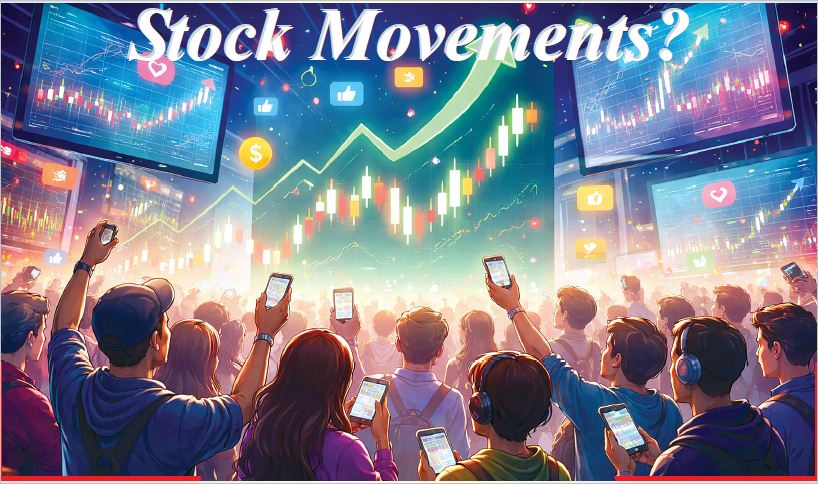
Charu Bhatia | Business Remedies | In today’s hyper-connected world, stock market behaviour is no longer shaped solely by fundamentals, institutional research or macroeconomic indicators. Increasingly, social trends, fuelled by online communities, influencers and real-time information sharing, are driving investment decisions. This phenomenon, often referred to as herd investing, is reshaping how markets move, sometimes with surprising speed and intensity.
Herd investing occurs when individuals follow the actions of a larger group rather than making independent, research-backed decisions. While this behaviour has always existed in financial markets, the rise of social media platforms, messaging forums and “finfluencers” has amplified its scale. A single trending stock recommendation or viral post can trigger a wave of buying or selling, pushing prices beyond their intrinsic value.
Retail investors, in particular, are playing a significant role in this shift. Easy access to trading apps and bite-sized financial content has democratised investing, but it has also blurred the line between informed decision-making and impulsive participation. Stocks that gain traction online often witness sudden spikes in trading volumes, driven more by sentiment than by earnings or growth potential.
One of the key drivers behind herd behaviour is the fear of missing out (FOMO). When investors see others profiting from a rising stock, the urgency to participate increases, often overriding caution. This creates a self-reinforcing cycle, prices rise because more people are buying, and more people buy because prices are rising. However, such momentum can reverse just as quickly, leading to sharp corrections and losses for late entrants.
Social validation also plays a crucial role. Online discussions, viral success stories and community-driven narratives can create a sense of collective confidence, even when underlying fundamentals are weak. In some cases, this has led to the formation of short-term bubbles, where valuations are driven more by hype than by financial performance.
That said, herd investing is not entirely negative. It has increased market participation and brought financial awareness to a broader audience. It has also challenged traditional market hierarchies, giving retail investors a stronger voice. However, the risks remain significant, particularly for those who rely solely on trends without understanding the underlying assets.
For investors, the key lies in balancing awareness with discipline. While tracking market sentiment can offer insights, decisions must ultimately be grounded in research, risk assessment and long-term goals.
As social influence continues to grow, herd investing is likely to remain a defining feature of modern markets, making it more important than ever to distinguish between momentum driven by value and momentum driven by noise.