

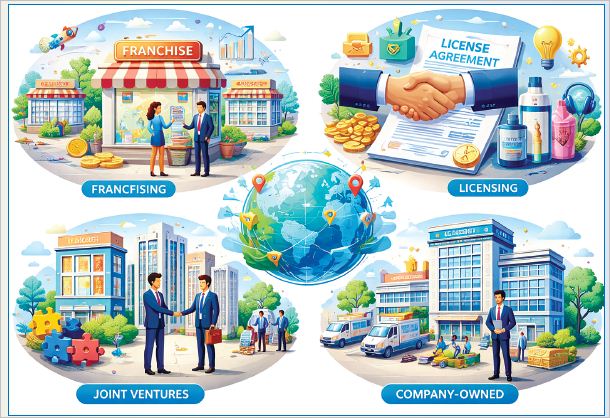
Charu Bhatia | Jaipur | Business Remedies | As businesses look for new ways to scale and reach wider markets, choosing the right expansion model has become a key strategic decision. Companies today have multiple options, from franchising and licensing to joint ventures and direct ownership, each offering distinct advantages depending on the nature of the business and its long-term goals. Understanding these models can help entrepreneurs and organisations adopt the most efficient pathway to growth.
Franchising: A Popular Route For Rapid Expansion
Franchising is ane of the most widely used business expansion models, particularly in sectors such as food service, retail and hospitality. In this model, a company (the franchisor) allows an independent operator (the franchisee) to use its brand name, business processes and operational systems in exchange for an initial fee and ongoing royalties.
This model allows companies to expand quickly with relatively lower capital investment since franchisees fund the setup and daily operations. For franchisees, the benefit lies in operating under an established brand with proven business practices, reducing the risks typically associated with starting a new venture.
Licensing: Leveraging Intellectual Property
Licensing is another effective model where a company permits another business to use its intellectual property, technology or brand for a specific period. Unlike franchising, licensing usually involves fewer operational controls from the original company.
This model is particularly common in industries such as fashion, entertainment, technology and consumer goods. Licensing helps businesses expand their reach without significant operational involvement, while licensees benefit from established brand recognition and specialised expertise.
Joint Ventures: Strategic Partnerships For Growth
Joint ventures involve two or more companies collaborating to create a new business entity or project. Each partner contributes resources such as capital, expertise or distribution networks, sharing both risks and rewards.
This model is often used when companies enter new markets or develop innovative products. For example, international firms frequently partner with local businesses to better understand regional markets, regulations and consumer behaviour.
Company-Owned Expansion: Full Control, Higher Investment
Some organisations prefer direct expansion through company-owned outlets or subsidiaries. In this model, the parent company maintains full ownership and control over operations, branding and quality standards.
While this approach requires higher capital investment, it allows businesses to maintain consistency and protect brand identity more effectively. It is often favoured by companies with strong financial resources and long-term growth plans.
Choosing The Right Model
Each business expansion model offers unique advantages. Franchising enables rapid scaling, licensing maximises brand value, joint ventures provide strategic collaboration, and company-owned operations ensure complete control. The best choice depends on factors such as industry type, investment capacity, market conditions and long-term business objectives.
As competition intensifies across industries, selecting the right growth model is becoming an essential part of business strategy. Companies that carefully evaluate these options are more likely to achieve sustainable expansion while managing risks effectively in an evolving global marketplace.