


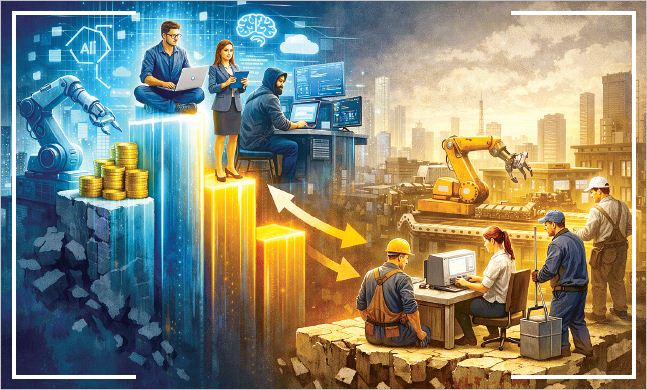
Charu Bhatia | Business Remedies| As technology continues to transform global industries, it is also reshaping wage structures in the labour market. While digital innovation has created new opportunities and boosted productivity, economists argue that it may also be widening the income gap between high-skill and low-skill workers.
The rise of technologies such as artificial intelligence, automation, cloud computing and advanced data analytics has significantly increased demand for specialised skills. Professionals with expertise in areas like software development, data science, cybersecurity and machine learning are now among the most sought-after employees in the global job market. As a result, these workers often command higher salaries and better career prospects.
According to research by the Organisation for Economic Co-operation and Development (OECD), technological advancements tend to favour workers with higher education and specialised digital skills. Companies increasingly rely on skilled professionals who can design, operate and manage complex technological systems, while routine tasks are more likely to be automated.
This shift has contributed to what economists call “skill-biased technological change.” In simple terms, technology raises productivity and wages for highly skilled workers while reducing demand for routine or repetitive jobs. Roles in manufacturing, clerical work and basic administrative tasks are particularly vulnerable to automation, which may limit wage growth in these sectors.
A report by the World Economic Forum also highlights that digital transformation is accelerating the need for advanced skills, including analytical thinking, problem solving and technological literacy. Workers without access to these skills may struggle to keep up with changing job requirements, potentially widening economic inequality.
However, technology is not solely responsible for wage disparities. Experts note that factors such as education systems, training opportunities and labour policies also play a major role in determining how benefits from technological progress are distributed.
Ultimately, while technology continues to drive economic growth and productivity, its benefits may not be evenly distributed. Addressing wage inequality will require coordinated efforts from businesses, educators and policymakers to ensure that the future of work remains inclusive.