


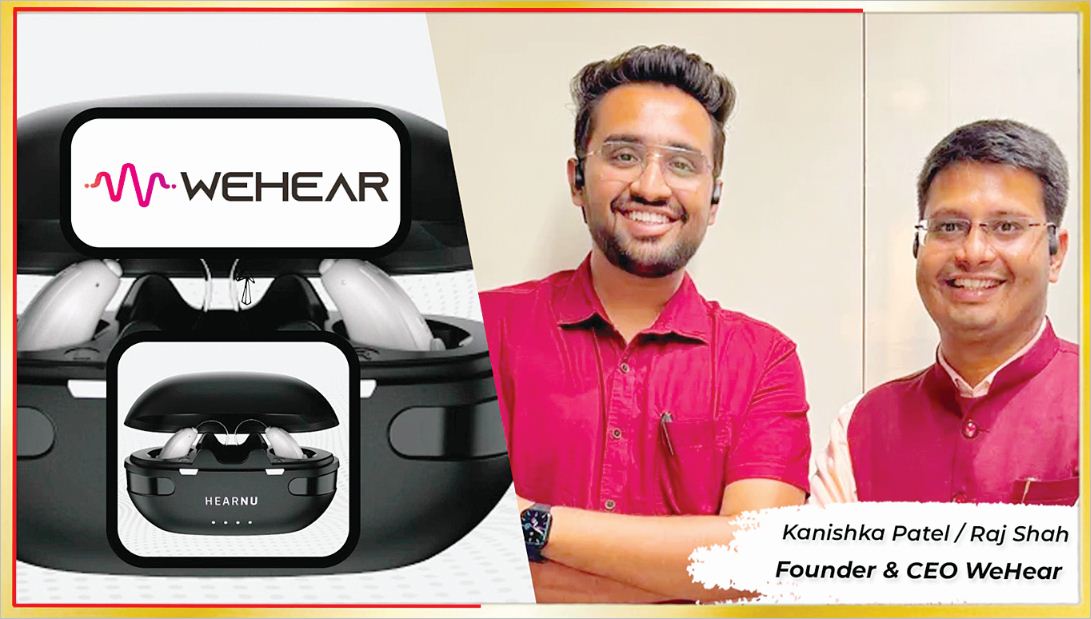
Rajshree Upadhyaya | Business Remedies | In 2017, in Ahmedabad, Gujarat, Kanishka Patel and Raj Shah came together with a shared belief that hearing loss should not automatically mean invasive surgery or lifelong dependence on expensive medical interventions. That belief became the foundation of WeHear, a hearing technology startup shaped by empathy, engineering curiosity, and a strong sense of social purpose. From its earliest days, the company was driven by a single question that would define its identity: could sound reach the brain without passing through the conventional pathways of the ear?
Kanishka Patel’s deep interest in electronics, robotics, and sound engineering laid the technical groundwork for the venture. During his engineering years, exposure to real-life stories of people living with hearing disabilities pushed him to look beyond traditional hearing aids and cochlear implants. Along with Raj Shah, who brought structure, strategy, and business clarity to the venture, Kanishka began exploring bone conduction technology, a science that allows sound vibrations to travel through the skull directly to the cochlea, bypassing damaged parts of the ear entirely.
This research and experimentation led to WeHear’s defining innovation, HearNU, a patented non-surgical bone conduction hearing device. Built for individuals with partial to profound hearing loss, HearNU was designed as a wearable solution that eliminated surgical risks while remaining far more affordable than implanted alternatives. Positioned near the temporal bone, the device enabled sound perception without relying on the ear canal, offering users clarity, comfort, and renewed confidence in everyday communication. Over time, HearNU became more than a product; it became the emotional core of the WeHear brand.
As the company evolved, the founders expanded their vision beyond clinical hearing assistance. WeHear introduced WeHear OX, an open-ear bone conduction smart audio device created for everyday listening while prioritizing auditory health. Unlike conventional in-ear headphones, WeHear OX allowed users to remain aware of their surroundings, addressing concerns around safety and long-term ear damage. Features such as real-time language translation reflected the brand’s ambition to merge accessibility, lifestyle, and innovation into a single audio experience. Alongside these offerings, WeHear continued developing advanced hearing solutions tailored to different levels and types of hearing loss, steadily building a diversified product ecosystem.
Support from incubation programs played a key role in shaping WeHear’s early growth, allowing the founders to refine prototypes, strengthen research, and scale production. Gradually, HearNU found adoption across diverse age groups, including children and adults, and reached users beyond India as well. Partnerships with institutions and community-focused initiatives helped amplify the social impact of the technology, particularly in cases where hearing challenges had previously limited education, communication, or social inclusion.
A major milestone in WeHear’s journey came with its appearance on Shark Tank India Season 3. Kanishka and Raj’s pitch stood out for its blend of technical depth and emotional honesty, clearly communicating both the science behind their innovation and the human impact it carried. The presentation resonated strongly with Peyush Bansal, who invested Rs. 2.5 crore for approximately 1 percent equity along with an advisory role, placing the company at a valuation of around Rs. 250 crore. The moment marked national recognition for a startup that had quietly been building transformative technology.
Following this visibility, WeHear focused on strengthening its brand presence, refining its product line, and deepening its commitment to research-driven innovation. The journey of WeHear reflects a careful balance between engineering precision and human empathy, where technology is not built for novelty but for meaningful change.
Today, WeHear represents a new wave of Indian innovation in hearing technology. Through HearNU, WeHear OX, and its expanding range of hearing solutions, Kanishka Patel and Raj Shah continue to challenge long-held assumptions about hearing care, guided by the belief that sound should be accessible, dignified, and free from unnecessary barriers.
 Written & Edited By:
Rajshree Upadhyaya