

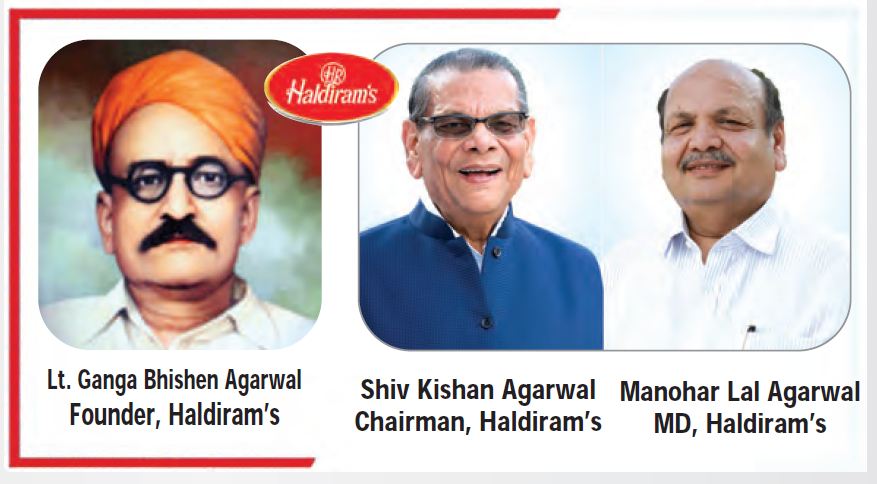
Rajshree Upadhyaya | Jaipur | Business Remedies | April 26,2025 | The story of Haldiram’s began over a century ago in the dusty lanes of Bikaner, Rajasthan, where an 11 year-old boy named Ganga Bhishen Agarwal started working at his father’s modest bhujia shop. Later known as Haldiram Ji, he would revolutionize Indian snacking by tweaking the traditional bhujia recipe, replacing gram flour with moth dal to make it thinner and crunchier. He branded it “Dungar Sev” after a Bikaner royal and priced it higher than competitors, a bold move that worked. With just one product and sharp intuition, he laid the foundation of a legacy of quality, innovation, and a premium identity.
In the 1960s, his descendants expanded the business beyond Rajasthan, first to Kolkata and then to Nagpur. In Nagpur, where bhujia was virtually unknown, Shiv Kishan Agarwal, Haldiram Ji’s grandson, stepped in. Understanding the challenge of entering a new market, he began with sweets like Kaju Katli, offering free samples to win over hesitant customers. Once trust was built, he slowly introduced the traditional Bikaneri flavors. Realizing that local tastes mattered, he launched a full-service restaurant serving not just snacks but also popular Indian dishes like dosa and samosa. Within three years, Haldiram’s had grown sales in Nagpur by 400 percent, proving that thoughtful adaptation could open new doors.
As the brand expanded, it needed someone with a broader vision. That person was Manohar Lal Agarwal, another grandson of Haldiram Ji, who joined in 1973. He realized that while the snacks were loved, the packaging failed to reflect their quality. Most products were sold loose or in simple plastic bags. Manohar Lal introduced modern packaging, zip-locks, four-layer pouches, and nitrogen-flushed packs, that extended shelf life, ensured hygiene, and elevated the brand’s appeal. These changes weren’t just cosmetic; they were pivotal in making Haldiram’s a name that stood for quality and consistency across markets.
With stronger branding and improved packaging, Haldiram’s grew beyond its stronghold in Delhi’s Chandni Chowk. It entered cities like Mumbai, Jaipur, and Kolkata, and then spread internationally. The Indian diaspora embraced the brand in the US, UK, UAE, Australia, and Japan. Understanding its diverse audience, Haldiram’s launched sub-brands like Minute Khana for ready meals and Cookie Heaven for biscuits, solidifying its position in the FMCG space. Even when it faced a regulatory hiccup in the US in 2015, comparable to the Maggi controversy, Haldiram’s bounced back swiftly by reinforcing quality controls and forming strategic partnerships, like those with Indian Railways for in-station kiosks.
Despite being split into separate family-run units across Delhi, Nagpur, and Kolkata, the brand has maintained a unified identity. In March 2025, Haldiram’s attracted global attention when Singapore-based Temasek acquired a 10 percent stake for over INR 8,000 crore, valuing the company at nearly $9 billion. With over 15,000 employees and a portfolio of more than 410 products, Haldiram’s is no longer just a snack brand, it’s a cultural icon. Its reach extends to over 80 countries, and with plans to go public soon, it’s poised for even greater expansion. At its heart, the Haldiram’s story is one of evolution without losing essence. From Ganga Bhishen Agarwal’s humble beginnings to Manohar Lal’s forward-looking leadership, every chapter has balanced tradition with transformation. What started as a tiny shop in Bikaner has grown into a global empire, and its journey is far from over.
 Written & Edited By:
Rajshree Upadhyaya