

Jaipur | Charu Bhatia | For decades, China stood at the centre of global manufacturing, attracting businesses with low production costs, massive industrial capacity and deeply integrated supply chains. From multinational corporations to small online retailers, companies across the world viewed China as the default destination for sourcing and manufacturing. However, rising geopolitical tensions, increasing tariffs and changing economic realities are now forcing businesses to reassess whether China remains the most viable long-term option.
Industry experts say the global manufacturing landscape is undergoing a significant transformation as companies seek more resilient and diversified supply chains. The shift gained momentum after the US-China trade war, which introduced tariffs on billions of dollars worth of Chinese goods. While initially intended to encourage domestic manufacturing and reduce dependence on China, the tariffs instead created cost pressures and uncertainty for businesses worldwide.
Entrepreneurs and startups, particularly those operating on thin margins, have felt the impact most sharply. Business models such as dropshipping, once heavily reliant on low-cost Chinese manufacturing and direct international shipping, now face rising logistics expenses, delays and fluctuating trade regulations.
At the same time, geopolitical competition between the United States and China has expanded beyond trade into technology, security and strategic industries. Concerns surrounding sanctions, export restrictions and supply chain disruptions have increased risks for businesses dependent on Chinese manufacturing.
China’s domestic economy is also evolving. Rising labour costs and stricter regulatory environments have reduced some of the low-cost advantages that initially made the country a global manufacturing powerhouse. Programmes such as “Made in China 2025,” aimed at strengthening technological self-reliance, have further intensified concerns in Western markets over competition and intellectual property protection. Despite these challenges, China continues to retain several major advantages. Its manufacturing ecosystem remains unmatched in scale, particularly in electronics, machinery and complex industrial production. The country also offers advanced infrastructure, efficient logistics networks and a vast domestic consumer market that continues to attract global brands.
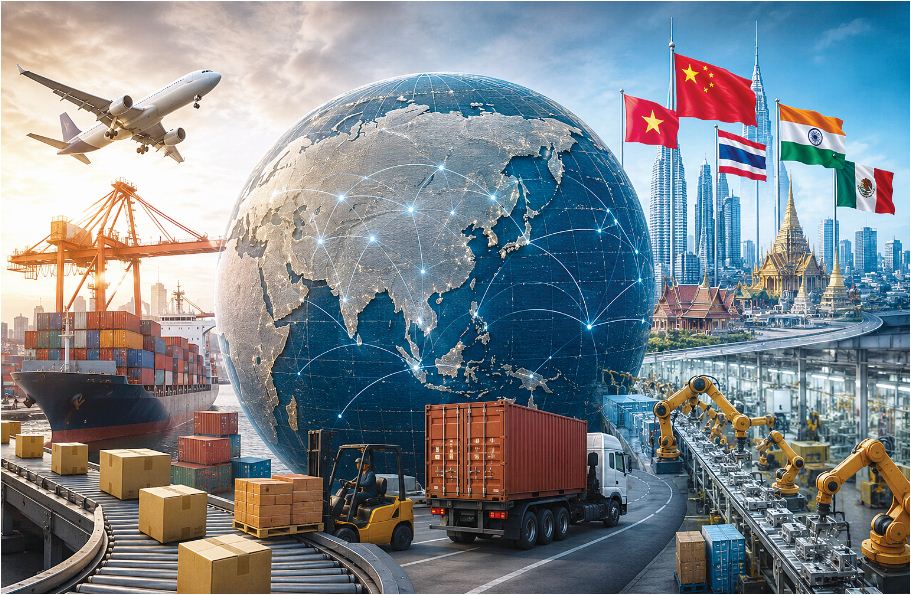
For businesses producing high-volume or technologically sophisticated goods, China still provides operational efficiencies that are difficult to replicate elsewhere. Additionally, many existing global supply chains remain deeply embedded in Chinese industrial networks, making relocation both expensive and time-consuming. However, companies are increasingly exploring alternatives across Asia and beyond. Countries such as Vietnam, Indonesia and Thailand are emerging as popular manufacturing destinations due to lower labour costs and expanding industrial capabilities. Mexico has also gained attention because of its proximity to the US market and trade advantages under the USMCA agreement.
India, meanwhile, is being viewed as a long-term manufacturing opportunity, supported by its large workforce and government-led industrial initiatives, though infrastructure and regulatory challenges remain concerns for investors. Experts say the future of global manufacturing will likely revolve around diversification rather than complete decoupling. Businesses are now prioritising supply chain resilience, regional manufacturing hubs and reduced dependence on any single country as they adapt to an increasingly uncertain global economic environment.