
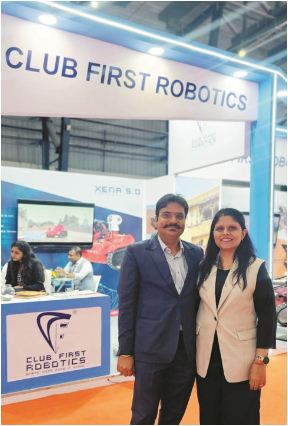
Charu Bhatia, Senior News Editor, Business Remedies, in conversation with Dr. Neelima Mishra, Founder Director of Club First Robotics Pvt. Ltd.
India’s robotics industry is steadily moving from experimentation to real-world deployment, driven by advances in artificial intelligence, automation, and a growing emphasis on technological self-reliance. Among the entrepreneurs contributing to this transformation is Dr. Neelima Mishra, Founder and Director of Club First Robotics Pvt. Ltd., a company focused on developing indigenous robotic solutions for sectors such as defense, firefighting, disaster management, industrial safety, and municipal services. In this interview, Dr. Mishra discusses her entrepreneurial journey, the evolution of the robotics sector, the role of emerging technologies, the impact of the Make in India initiative, and why she believes human-robot collaboration will define the future of work.
Question: What inspired you to establish a robotics manufacturing company, and how has the journey evolved over the years?
Answer: The inspiration came from a shared vision between my husband, Mr. Bhuvanesh Mishra, and me to create indigenous robotic solutions that could solve real-world challenges in India. We recognized that critical sectors such as defense, firefighting, disaster response, and industrial safety relied heavily on imported technologies. We believed India had the talent and capability to design and manufacture world-class robotic systems domestically.
What started as a dream has evolved into a leading robotics manufacturing company with deployments across multiple states and strategic sectors. Today, our robots are supporting firefighters, defense personnel, municipal corporations, and industries, reflecting our commitment to innovation and nation-building.
Question: What were the biggest challenges you faced during the initial stages of the business?
Answer: The biggest challenges were creating awareness about robotics, securing funding for deep-tech innovation, building a skilled workforce, and convincing customers to trust an Indian-made robotic solution. Manufacturing advanced robotics requires significant investment in R&D and continuous testing.
As a startup, we had to prove that Indian technology could match global standards. Through perseverance, successful field deployments, and customer confidence, we overcame these challenges and established credibility in the market.
Question: How has the robotics industry changed since you started?
Answer: The robotics industry has transformed dramatically. Earlier, robotics was considered a luxury or futuristic concept. Today, it is viewed as a necessity for improving safety, productivity, and operational efficiency.
The integration of Artificial Intelligence, IoT, autonomous navigation, and advanced sensors has expanded the scope of robotics. Industries and government agencies are increasingly adopting robotic systems, and India is witnessing a growing ecosystem of innovators, startups, and manufacturers.
Question: What types of robotic solutions does your company specialize in?
Answer: At Club First Robotics, we specialize in developing unmanned ground vehicles (UGVs), firefighting robots, disaster response robots, defense robots, manhole cleaning robots, AI-enabled humanoid service robots, and industrial automation solutions.
Our focus is on creating rugged, reliable, and mission-critical robotic systems that can operate in hazardous environments where human intervention may be risky or inefficient.
Question: What is the typical lifecycle of a robotics product, from concept to commercialization?
Answer: The lifecycle begins with identifying a real-world problem and understanding customer requirements. This is followed by concept development, design engineering, simulation, prototype development, testing, field trials, and product refinement.
Once the product successfully meets operational requirements, we proceed with certification, manufacturing, deployment, training, and after-sales support. Continuous customer feedback helps us improve and evolve the product further.
Question: How do you integrate emerging technologies such as AI, machine learning, and IoT into your robotic systems?
Answer: Emerging technologies are central to our development strategy. AI and machine learning enable robots to identify objects, understand environments, and make intelligent decisions. IoT helps in remote monitoring, predictive maintenance, and real-time data transmission.
By combining these technologies with advanced sensors, thermal imaging, autonomous navigation, and analytics, we create robotic systems that are smarter, safer, and more efficient.
Question: Which industries currently drive the highest demand for your robotic solutions and why?
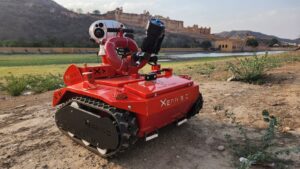 Answer: Currently, the highest demand comes from defense, firefighting services, disaster management agencies, oil and gas industries, municipal corporations, and critical infrastructure sectors.
These industries operate in high-risk environments where robotics significantly improves safety, reduces operational risks, and enhances efficiency. Organizations are increasingly realizing that robotics is not just an investment in technology but an investment in human safety.
Question: Is robotics replacing jobs or creating new opportunities for the workforce?
Answer: I strongly believe robotics is creating more opportunities than it is replacing. Robots are primarily taking over repetitive, hazardous, and physically demanding tasks.
At the same time, robotics is generating new jobs in design, manufacturing, software development, AI engineering, maintenance, operations, training, and system integration. The future workforce will collaborate with robots rather than compete against them.
Question: How has the Make in India initiative influenced your growth strategy?
Answer: The Make in India initiative has played a significant role in encouraging indigenous manufacturing and innovation. It has created opportunities for startups like ours to develop advanced technologies within the country.
The initiative has strengthened our confidence to invest in R&D, manufacturing infrastructure, and talent development while contributing to India’s vision of technological self-reliance and Atmanirbhar Bharat.
Question: What role should educational institutions play in preparing students for the robotics industry?
Answer: Educational institutions must focus on practical learning, interdisciplinary education, innovation, and problem-solving. Robotics combines mechanical engineering, electronics, software, AI, and data science.
Universities should establish robotics laboratories, industry partnerships, innovation centers, and startup incubation programs to expose students to real-world applications and emerging technologies.
Question: Are Indian manufacturers adopting robotics at a pace equivalent to the world?
Answer: India is progressing rapidly, but there is still significant scope for growth compared to highly automated economies. Large industries have started adopting robotics aggressively, while many MSMEs are still in the early stages.
However, the pace is accelerating due to increasing awareness, cost-effective solutions, government support, and the growing need for productivity and safety improvements.
Question: What policy changes would you like to see to encourage innovation in advanced manufacturing?
Answer: I would like to see increased support for deep-tech startups through R&D grants, easier access to funding, stronger industry-academia collaboration, faster certification processes, and incentives for indigenous technology adoption.
Policies that encourage local procurement and long-term innovation investments can significantly strengthen India’s advanced manufacturing ecosystem.
Question: How do you envision the future of human-robot collaboration?
Answer: The future is not about robots replacing humans; it is about humans and robots working together. Robots will handle dangerous, repetitive, and data-intensive tasks, while humans will focus on decision-making, creativity, and strategic operations.
This collaboration will improve productivity, safety, and quality of life across industries. Human-robot collaboration will become a standard part of workplaces in the coming decade.
Question: What message would you like to share with young engineers and aspiring entrepreneurs interested in robotics and advanced manufacturing?
Answer: India is entering a transformative era of technological innovation, and robotics will play a major role in shaping the future. I encourage young engineers to think beyond conventional career paths and focus on solving real-world problems.
Be curious, embrace continuous learning, and do not fear failure. Innovation requires persistence and courage. If you combine technical expertise with determination, you can create technologies that not only build successful businesses but also contribute meaningfully to society and the nation.