

Dhairyavardhan Singh Rajawat | Jaipur, March 2 | For the last two months, Foreign Institutional Investor’s have made huge net sales in the Indian stock markets. However, during this period, Domestic institutional investor’s have made net purchases in the stock markets. But still a huge fall has been recorded in BSE Large Cap, Mid Cap and Small Cap indices. A big fall has also been recorded in Nifty 50. FIIs have made net purchases of Rs. 242699.59 crore and net sales of Rs. 330074.25 crore in January 2025.
Thus, in January 2025, FIIs have made a total sale of Rs. 87374.66 crore. Foreign institutional investors have made net purchases of Rs. 259256.89 crore and net sales of Rs. 318244.97 crore in February 2025. Thus, in February 2025, foreign institutional investors have made a total sale of Rs. 58988.08 crore. DIIs have made net purchases of Rs. 339689.44 crore and net sales of Rs. 253097.64 crore in January 2025. Thus, in January 2025, FIIs have made total purchases of Rs. 86591.80 crore. DIIs have made net purchases of Rs. 277187.00 crore and net sales of Rs. 212333.81 crore in February 2025. Thus, in February 2025, DIIs have made a total purchase of Rs. 64853.19 crore.
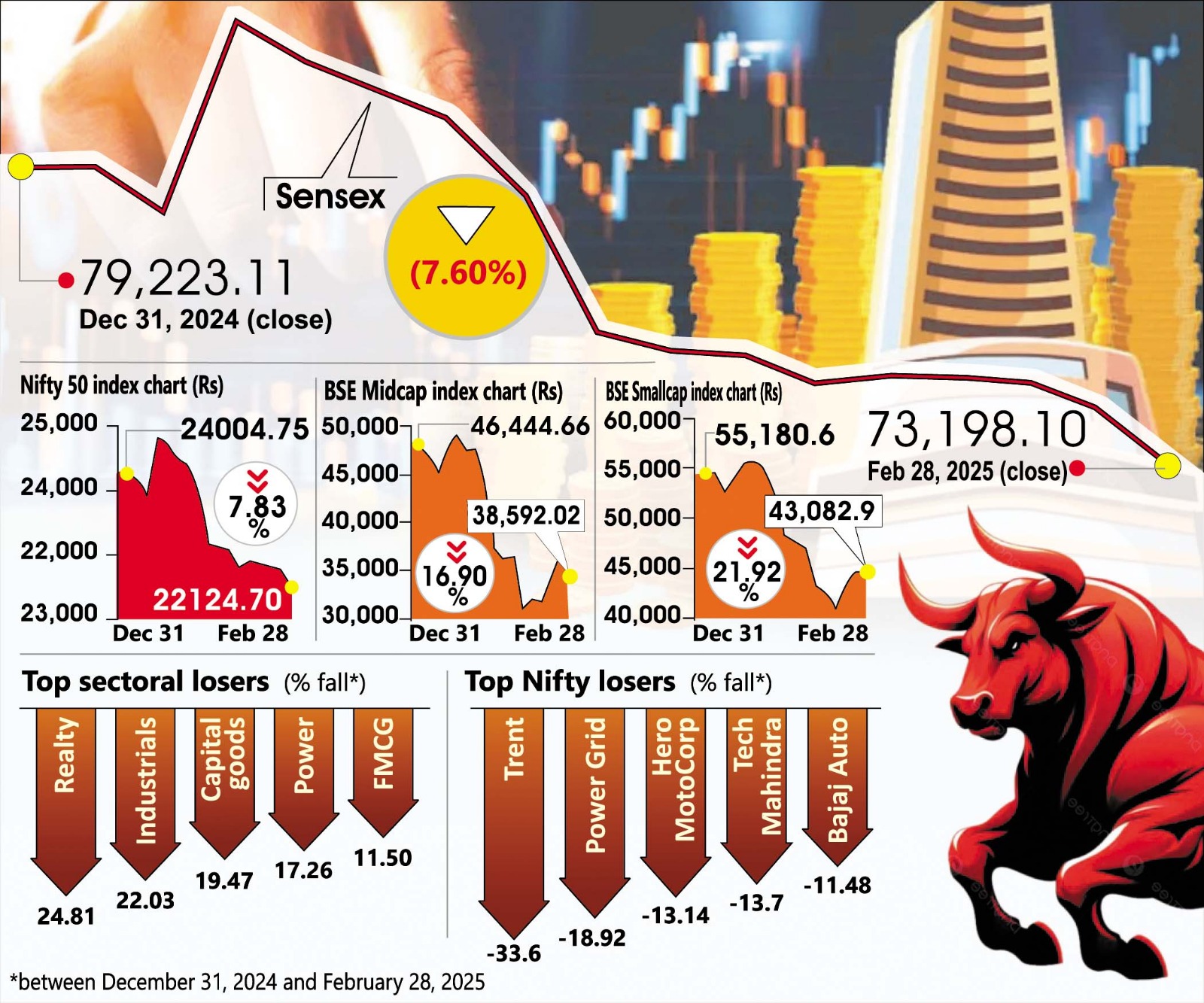
Nifty 50 shares have also seen a decline in the last two months. Trent Limited, a Tata Group company included in Nifty 50, recorded a closing price of Rs. 4851.55 on 28 February 2025 compared to the closing price of Rs. 7307.70 on 31 December 2024. On this basis, a decline of 33.61 percent has been recorded in the company’s shares. Power Grid Limited, a PSU company included in Nifty 50, recorded a closing price of Rs. 250.85 on 28 February 2025 compared to the closing price of Rs. 309.40 on 31 December 2024.
On this basis, a decline of 18.92 percent has been recorded in the company’s shares. Automobile company Hero Moto Corp Limited, included in Nifty 50, recorded a closing price of Rs. 3681.10 on 28 February 2025 compared to the closing price of Rs. 4237.95 on 31 December 2024. On this basis, a decline of 13.13 percent has been recorded in the company’s shares. Tech Mahindra Limited, a Mahindra Group company included in Nifty 50, recorded a closing price of Rs. 1487.85 on 28 February 2025 compared to the closing price of Rs. 1711.65 on 31 December 2024.
On this basis, a decline of 13.07 percent has been recorded in the company’s shares. Bajaj Auto Limited, a Bajaj Group company included in Nifty 50, recorded a closing price of Rs. 7902.90 on 28 February 2025 compared to the closing price of Rs. 8928.20 on 31 December 2024. On this basis, a decline of 11.48 percent has been recorded in the company’s shares. Along with large cap, mid cap and small cap indices have also seen a huge decline. BSE Mid cap Index fell by 16.90 percent from the closing price of 46444.66 on December 31, 2024 to the level of 38592.02 on February 28, 2025.
Similarly, the BSE Small Cap Index fell by 21.92 percent from the closing price of 55180.6 on December 31, 2024 to the level of 43082.9 on February 28, 2025. During this period, sector related indices of BSE also recorded a decline. The BSE Industrial Index fell by 22.03 percent from the closing price of 14911.98 on December 31, 2024 to the level of 11626.33 on February 28, 2025. The BSE Capital Goods Index fell by 19.47 percent from the closing price of 68604.11 on December 31, 2024 to the level of 55241.12 on February 28, 2025.
BSE’s Reality Index fell by 24.81 percent from the closing price of 8234.10 on December 31, 2024 to the level of 6191.16 on February 28, 2025. The BSE FMCG index fell by 11.50 percent from the closing price of 20771.92 on December 31, 2024 to the level of 18382.82 on February 28, 2025. Experts believe that the movement of the stock market in the coming time will depend on the attitude of foreign institutional investors towards emerging markets, tariffs, the circumstances of the Russia-Ukraine war, peace in the Middle East and the outcome of monetary policy.


