

BR Team | Jaipur
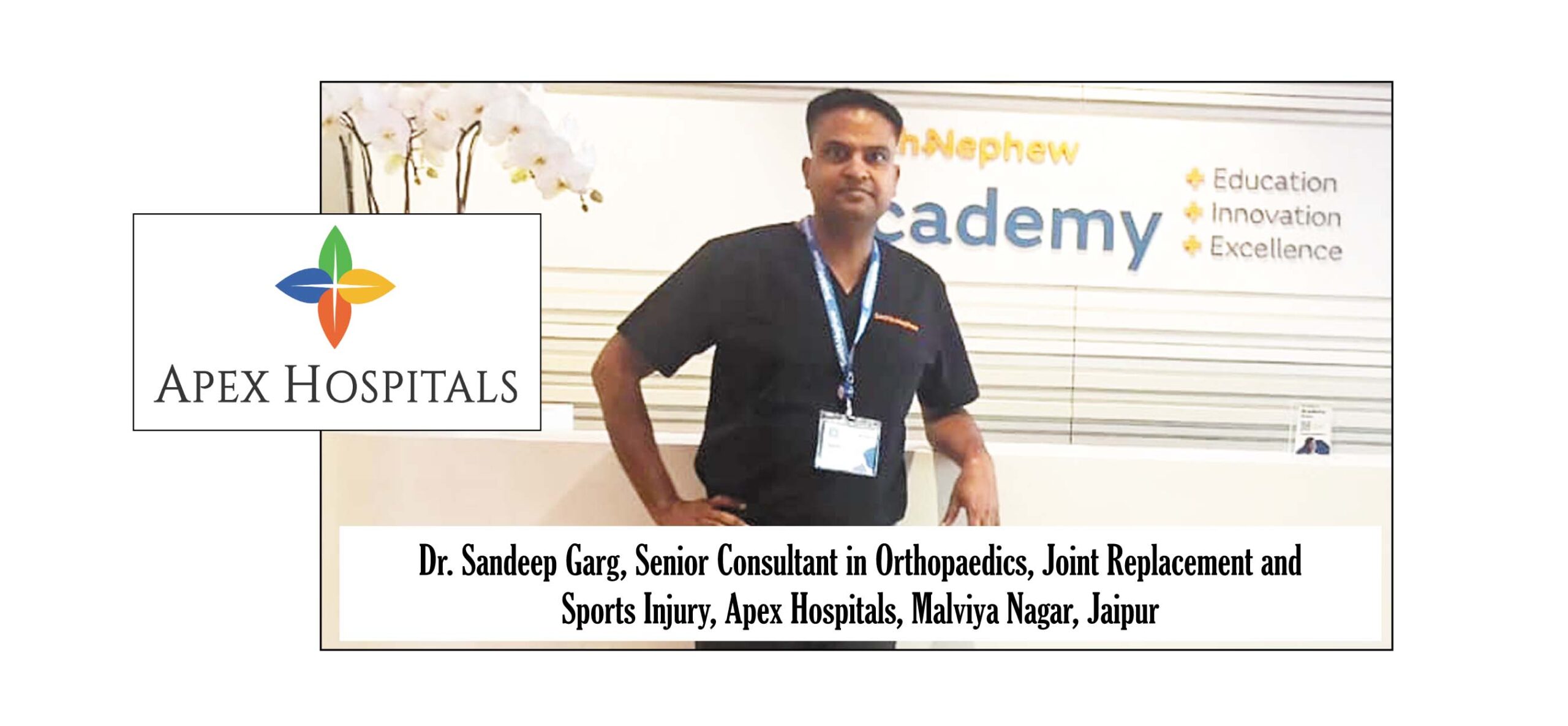
With over 15 years of experience in orthopedics, Dr. Sandeep Garg, Senior Consultant in Orthopaedics, Joint Replacement and Sports Injury at Apex Hospitals, Malviya Nagar, Jaipur, has established himself as an expert in advanced joint replacement, sports injury management, and complex trauma care. Trained at SMS Medical College, Jaipur, with fellowships in Arthroplasty and Arthroscopy from the Johnson & Johnson (J&J) Institute, USA, and Shoulder Arthroscopy under the IOA Fellowship, Dr. Garg is known for performing complex procedures. In this exclusive conversation with Business Remedies, he reflects on his journey, the evolution of orthopedic care, the growing role of robotics and AI, and the importance of preventive bone health in today’s fast-changing healthcare landscape.
You are a renowned orthopedic surgeon at Apex Hospitals, Malviya Nagar, Jaipur. Please tell us about your journey so far and what inspired you to pursue orthopedics.
A: I come from Nadbai in Rajasthan’s Bharatpur district, where I completed my schooling. I later pursued my MBBS and MS in Orthopaedics from SMS Medical College, Jaipur. To further strengthen my surgical expertise, I underwent fellowships in Arthroplasty and Arthroscopy from the Johnson & Johnson (J&J) Institute, USA, and completed the prestigious IOA Fellowship in Shoulder Arthroscopy at Pune in 2011. Over the past 15 years, I have been dedicated to advancing orthopedic care through continuous learning, innovation, and patient-centric treatment.
Currently, I serve as Senior Consultant in Orthopaedics, Joint Replacement and Sports Injury at Apex Hospitals, Malviya Nagar, Jaipur. I am also a faculty member at the Indian Arthroplasty Association Conference and was honoured with the YUVA Mentor Fellowship in 2024. During my career, I have performed more than 100 individual joint replacement surgeries at Apex Hospitals and have managed several complex and rare orthopedic cases.
My decision to specialise in orthopedics, however, was driven by a deeply personal experience. My father suffered from chronic knee problems, while my grandfather also dealt with orthopedic ailments. Watching them struggle with pain and limited mobility inspired me to pursue this field so that I could help people regain movement and improve their quality of life. Those experiences shaped my career and strengthened my commitment to orthopedic surgery.
Today, I remain focused on delivering precise, evidence-based, and minimally invasive treatment to every patient. With advancements in technology and fellowship-trained surgical expertise, my goal is not only to relieve pain but also to restore confidence, mobility, and a better quality of life for patients facing even the most challenging orthopedic conditions.
Orthopedics has evolved tremendously over the years. How do you see this transformation?
A: Orthopedics has undergone a revolutionary transformation. Earlier, most fractures and bone injuries were treated conservatively through plaster casts, requiring long periods of immobilization and recovery.
Gradually, surgical interventions became more advanced, allowing patients to recover faster. The introduction of arthroscopy completely changed the management of joint disorders by enabling minimally invasive procedures with quicker rehabilitation.
Diagnostic technology has also improved significantly. Earlier, identifying complex bone and ligament injuries often took considerable time. Today, advanced MRI imaging helps us detect even minor problems early, leading to faster and more accurate treatment.
The latest advancement is robotic-assisted orthopedic surgery, which has enhanced precision, reduced surgical errors, and improved overall patient outcomes. These developments have made orthopedic treatment safer, more predictable, and far more patient-friendly.
What are the most common orthopedic problems you encounter in your practice?
A: Patients visit us with a wide variety of orthopedic conditions. Knee pain, shoulder pain, elbow injuries, hip disorders, spine-related issues, and musculoskeletal pain are among the most common complaints.
Many patients improve with lifestyle modifications, physiotherapy, medications, and proper rehabilitation. However, certain conditions require surgical intervention, especially advanced arthritis, ligament injuries, fractures, or severe joint damage.
Early diagnosis remains the key. Ignoring persistent pain often allows the condition to worsen, making treatment more complicated than it initially needed to be.
Artificial Intelligence and robotic technology are becoming increasingly important in healthcare. What role do they play in orthopedics?
A: Technology has transformed orthopedic surgery in remarkable ways. AI-assisted planning enables us to obtain extremely accurate anatomical measurements before surgery, helping surgeons make better clinical decisions.
Robotic systems further improve precision during joint replacement procedures by ensuring correct implant positioning and alignment. This not only enhances surgical accuracy but also improves the longevity and performance of orthopedic implants.
Modern minimally invasive surgical techniques have also reduced postoperative pain, minimized blood loss, shortened hospital stays, and accelerated recovery. Technology today is helping surgeons deliver safer and more efficient treatment while improving patients’ overall quality of life.
Osteoporosis is becoming increasingly common. Why is this happening, and how can it be prevented?
A: Osteoporosis is especially common among women after menopause because hormonal changes significantly reduce bone density. However, lifestyle factors are also contributing to its rising prevalence across different age groups.
A sedentary lifestyle, inadequate exposure to sunlight, poor nutrition, and vitamin D deficiency all weaken bones over time.
Fortunately, osteoporosis is largely preventable. Regular physical activity, weight-bearing exercises, balanced nutrition rich in calcium and vitamin D, adequate sunlight exposure, and maintaining a healthy lifestyle play an important role in preserving bone strength.
At what age should people begin undergoing Bone Density Tests?
A: Generally, individuals above the age of 50 should begin monitoring their bone health through Bone Mineral Density (BMD) testing, particularly those with risk factors such as menopause, family history, previous fractures, or long-term steroid use.
Regular screening helps detect osteoporosis in its early stages, allowing timely intervention before fractures occur. The frequency of testing should ultimately be determined by a physician based on an individual’s risk profile.
What are the warning signs of fractures and other bone problems? How can patients recover faster after a fracture?
A: A fracture usually presents with severe pain, swelling, inability to move the affected limb, tenderness, and sometimes deformity. Muscle or ligament injuries may also accompany bone trauma.
However, the exact diagnosis can only be confirmed through investigations such as X-rays and, when required, advanced imaging.
Persistent pain should never be ignored because it may result from poor posture, spine-related conditions, ligament injuries, or other orthopedic disorders.
For recovery, patients should strictly follow medical advice, consume a nutritious diet, undergo prescribed physiotherapy, and avoid putting unnecessary stress on the injured bone. While home remedies like hot fomentation may provide temporary relief in certain conditions, consulting an orthopedic specialist remains essential for proper diagnosis and treatment.
What lifestyle habits help maintain healthy bones throughout life?
A: Good bone health begins with proper nutrition. A balanced diet containing adequate protein, calcium, vitamins, and essential minerals is crucial. Milk, curd, leafy vegetables, pulses, sprouts, and dry fruits are excellent dietary sources that should be included regularly.
Equally important is maintaining proper posture, staying physically active, and not ignoring early symptoms such as persistent pain or stiffness. Regular exercise strengthens muscles, improves balance, and reduces the risk of fractures.
What are some common misconceptions about bone health?
A: One of the biggest misconceptions is that every bone pain indicates cancer. While certain bone cancers can present with pain, the vast majority of bone pain is caused by far more common conditions such as arthritis, muscle strain, ligament injuries, vitamin deficiencies, or posture-related problems.
Another common myth is that every injury results in a fracture. Many injuries involve soft tissues like ligaments, tendons, or muscles rather than the bone itself. Proper medical evaluation is therefore necessary instead of making assumptions based on symptoms alone.
How do you view the government’s support for orthopedic healthcare in India?
A: Government support has improved significantly over the years. Various public health schemes, including Ayushman Bharat and state-sponsored healthcare initiatives, have made quality orthopedic treatment more accessible and affordable, particularly for economically weaker sections.
Equally encouraging is the growing public awareness regarding healthcare. More people now seek treatment from qualified orthopedic specialists rather than depending on unqualified practitioners.
Advances in medical infrastructure have also expanded treatment options. Procedures that were once considered difficult or unavailable are now routinely performed, allowing patients to preserve mobility and lead healthier lives.
Finally, what message would you like to give to young medical aspirants?
A: Medicine is one of the most rewarding professions, but it also demands unwavering commitment. Success in this field requires years of hard work, continuous learning, discipline, and compassion.
Anyone choosing medicine should do so with a genuine desire to serve people rather than for status or financial rewards. Healthcare professionals carry tremendous responsibility, and dedication to patients must always remain the highest priority. If young aspirants are prepared to embrace that commitment, medicine offers immense opportunities to make a meaningful difference in society.