


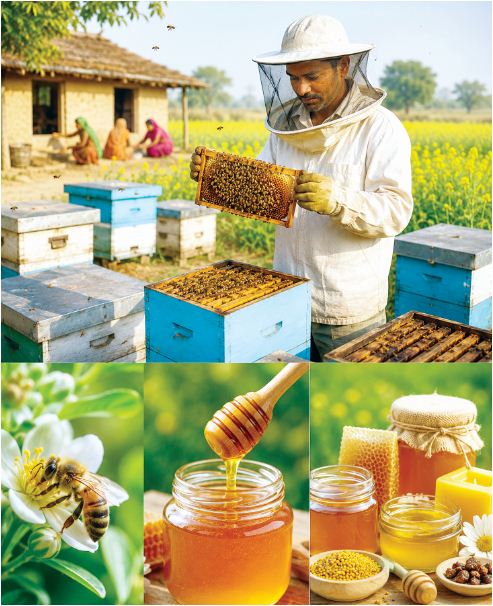
Jaipur | Charu Bhatia | Beekeeping is emerging as one of India’s fastest-growing agri-based enterprises, offering farmers and rural entrepreneurs a sustainable source of additional income while supporting agricultural productivity. Driven by rising demand for natural honey, growing health awareness, and government support for apiculture, the sector is steadily transforming from a traditional practice into a profitable agribusiness. India is among the world’s leading honey producers and exporters, with key markets including the United States, Europe and West Asia. The increasing consumer preference for organic and minimally processed foods has boosted demand for premium honey varieties such as mustard, eucalyptus, litchi, acacia and multifloral honey. Alongside retail sales, honey is finding wider applications in the food processing, pharmaceutical, cosmetic and wellness industries, creating multiple revenue streams for producers.
Unlike many agricultural ventures, beekeeping requires relatively low initial investment and limited land. Farmers can integrate bee colonies with existing crops such as mustard, sunflower, fruits and vegetables, enabling them to earn from both honey production and improved crop yields. Experts estimate that pollination by honeybees can significantly enhance the productivity of several horticultural and oilseed crops, making beekeeping an important contributor to agricultural sustainability. Government initiatives have further strengthened the sector. Programmes under the National Beekeeping and Honey Mission (NBHM) and other agricultural schemes provide financial assistance, technical training, modern beekeeping equipment and market linkages to farmers and entrepreneurs. Several state governments are also encouraging apiculture through skill development programmes and cooperative models to increase rural employment.
Technology is playing a growing role in modern beekeeping. Digital platforms now help beekeepers monitor hive health, weather conditions and honey production, while e-commerce marketplaces enable direct-to-consumer sales, improving profit margins. Traceability and quality certification are also becoming increasingly important as international buyers seek premium, residue-free honey. The sector is witnessing the rise of value-added products beyond conventional honey. Beeswax, royal jelly, propolis, bee pollen and honey-based wellness products are gaining popularity, allowing producers to diversify their businesses and reduce dependence on a single product. Premium packaging and branding have also helped small producers tap urban and export markets.
Despite the positive outlook, challenges remain. Climate change, pesticide use, habitat loss and adulteration continue to affect bee populations and consumer confidence. Industry experts emphasise the need for stricter quality standards, better disease management and increased awareness about sustainable beekeeping practices. As India’s agriculture sector moves towards diversification and value addition, beekeeping is proving to be a promising enterprise that combines environmental benefits with economic returns. With supportive policies, technological adoption and growing consumer demand for natural products, honey production is poised to become an increasingly important pillar of the country’s rural economy and agribusiness landscape.


