
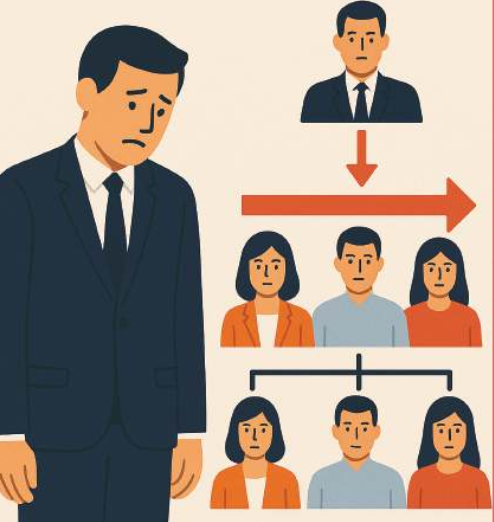
Charu Bhatia | Business Remedies | Across global and Indian corporations, a quiet but decisive structural shift is reshaping the way organisations operate. Middle management, once seen as the backbone that connected leadership with frontline teams, is steadily shrinking. As companies face pressure to stay agile, reduce costs, and adopt new technologies, the traditional multi-layered hierarchy is giving way to flatter, faster, and more flexible organisational models.
This transition is driven by a convergence of business realities. With automation and AI tools now capable of taking over reporting, monitoring and administrative tasks, many functions historically handled by middle managers no longer require human intervention. Real-time dashboards track performance. Generative AI prepares presentations, summarises data, and manages workflows. As a result, companies are beginning to question whether they need as many managerial layers to supervise routine operations.
Another major catalyst is speed. In an increasingly competitive market, organisations want decisions made quickly, without being slowed down by multiple levels of approval. Flatter structures help teams move from idea to execution faster by reducing bureaucratic friction. For technology companies and startups, this shift mirrors the agile methodology that prioritises autonomy and faster iteration cycles. Even traditional sectors, manufacturing, banking, insurance, and retail, are adopting similar structures as they digitise.
Cost efficiency also plays an undeniable role. Middle managers, often occupying well-compensated roles, are a significant expense on corporate balance sheets. During recent rounds of layoffs across industries, these positions have been among the most affected. Companies argue that streamlining layers not only cuts costs but also strengthens accountability by giving teams more ownership of outcomes.
However, the decline of middle management is not without consequences. For many organisations, middle managers have long served as the cultural glue, mentoring teams, resolving conflicts, and translating strategy into actionable work. Without them, the burden shifts directly to senior leaders, who may struggle to stay connected with rapidly expanding teams. Employees, too, can feel adrift, with fewer opportunities for career progression and guidance.
Some companies are trying to offset this by introducing new hybrid roles: team leads who rotate responsibilities, coaches who guide employees without formal managerial titles, and project-based leadership structures. Others are investing in stronger communication systems and leadership training to ensure that flatter hierarchies do not compromise team cohesion.
Still, the larger trend is clear: organisations are preparing for a future where agility, tech-enabled workflows, and cross-functional teams matter more than traditional hierarchies. As corporations continue to evolve, the role of middle management will not disappear entirely, but it is being redefined. Instead of merely supervising tasks, managers of the future will need to function as strategists, mentors, connectors, and culture builders.
The decline of middle management marks a pivotal moment in corporate evolution. It reflects companies’ efforts to balance efficiency with engagement, speed with stability, and technology with human leadership. And as this shift accelerates, the organisations that succeed will be the ones that rethink, not remove, the value that true leadership brings.