

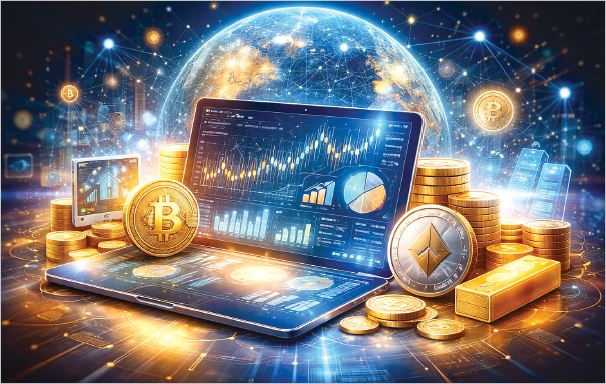
Charu Bhatia | Jaipur | Business Remedies | In recent years, digital assets have steadily emerged as an important component of modern wealth strategies. Once viewed as a niche or speculative investment, assets such as cryptocurrencies, tokenised securities, digital gold and even certain forms of digital collectibles are now increasingly being considered by investors looking to diversify their portfolios. Financial experts say this shift reflects broader changes in how people approach wealth creation in an increasingly digital economy.
One of the primary reasons digital assets are gaining traction is portfolio diversification. Traditional investment portfolios typically include equities, bonds, real estate and gold. Digital assets provide an additional asset class that behaves differently from conventional markets. This difference can sometimes help investors balance risk and potentially enhance long-term returns.
Another factor driving interest is increasing accessibility. Earlier, investing in emerging asset classes often required specialised knowledge or large capital. Today, digital platforms and fintech applications have simplified the process, allowing investors to buy small fractions of digital assets with relative ease. This has opened the door for younger investors and tech-savvy individuals who are comfortable using online financial platforms.
The appeal of digital assets also lies in their borderless nature. Unlike traditional investments that are often tied to specific geographies or financial institutions, many digital assets operate on decentralised networks. This allows investors to access global markets without many of the conventional barriers associated with international investing.
Another key development is the rise of tokenisation, a process through which physical or financial assets are converted into digital tokens on blockchain networks. This innovation has the potential to make previously illiquid assets, such as real estate or fine art, more accessible by allowing fractional ownership. For wealth managers and investors alike, tokenisation could reshape how assets are owned and traded in the future.
However, financial planners also caution that digital assets come with higher volatility and regulatory uncertainty. Prices can fluctuate significantly within short periods, and regulatory frameworks around the world are still evolving. As a result, experts often advise investors to treat digital assets as a small part of a diversified portfolio rather than a primary investment vehicle.
Despite these risks, the role of digital assets in personal finance conversations is growing rapidly. As technology continues to transform financial systems and investment opportunities, digital assets are likely to remain a key area of interest for investors seeking new ways to build and manage wealth.