

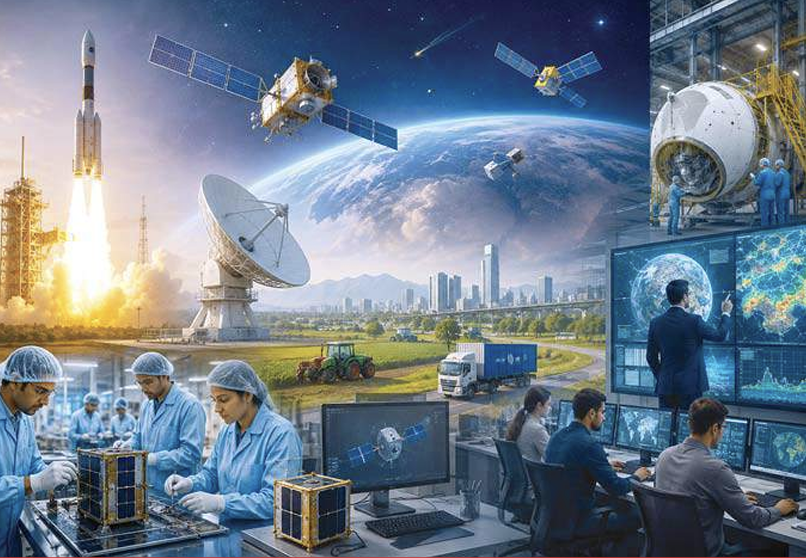
Jaipur | Charu Bhatia | India’s space sector is no longer driven solely by scientific ambition. It is rapidly emerging as a high-growth business opportunity, attracting startups, venture capital firms, manufacturers and global investors eager to participate in what could become one of the country’s most promising technology industries. The transformation gained momentum after the Indian government opened the space sector to private participation in 2020. Since then, more than 250 space-tech startups have emerged, working across satellite manufacturing, launch services, Earth observation, communication systems and space-based data analytics. Industry estimates suggest that India’s space economy, currently valued at around $8 billion, could grow to over $40 billion by 2040. This growth is being driven by increasing demand for satellite services, geospatial intelligence, climate monitoring, telecommunications and defence applications.
Among the fastest-growing segments is satellite manufacturing. Businesses across agriculture, logistics, urban planning and disaster management are increasingly relying on satellite-generated data for real-time decision-making. As a result, companies are investing heavily in smaller, cheaper and more efficient satellites that can be launched in large numbers.
Launch services are also becoming a major commercial opportunity. The success of ISRO’s cost-effective missions has positioned India as a competitive launch destination. Private players are now developing reusable rockets and small satellite launch vehicles aimed at serving global customers looking for affordable access to space. Another emerging trend is the monetisation of space-based data. Satellite imagery is being used by insurance companies to assess crop damage, by banks to evaluate agricultural lending risks, and by governments to monitor infrastructure projects. The growing demand for data-driven insights is creating a new business ecosystem around analytics platforms and artificial intelligence.
Investment activity reflects the sector’s potential. Space-tech startups have attracted hundreds of millions of dollars in funding over the past few years, with investors viewing the industry as a long-term strategic bet similar to the early days of fintech and electric mobility. The sector is also creating opportunities for traditional industries. Aerospace manufacturing firms, electronics suppliers and precision engineering companies are finding new markets as demand for spacecraft components and advanced materials rises.
Challenges remain, including regulatory approvals, high capital requirements and the long development cycles typical of scientific ventures. However, government initiatives, policy reforms and rising private-sector participation are helping reduce these barriers. As science increasingly intersects with commerce, India’s space industry is evolving from a government-led programme into a vibrant business ecosystem. The next decade could see space technology become one of the country’s most significant innovation-led growth stories, creating jobs, attracting investment and generating new economic opportunities far beyond the launchpad.