
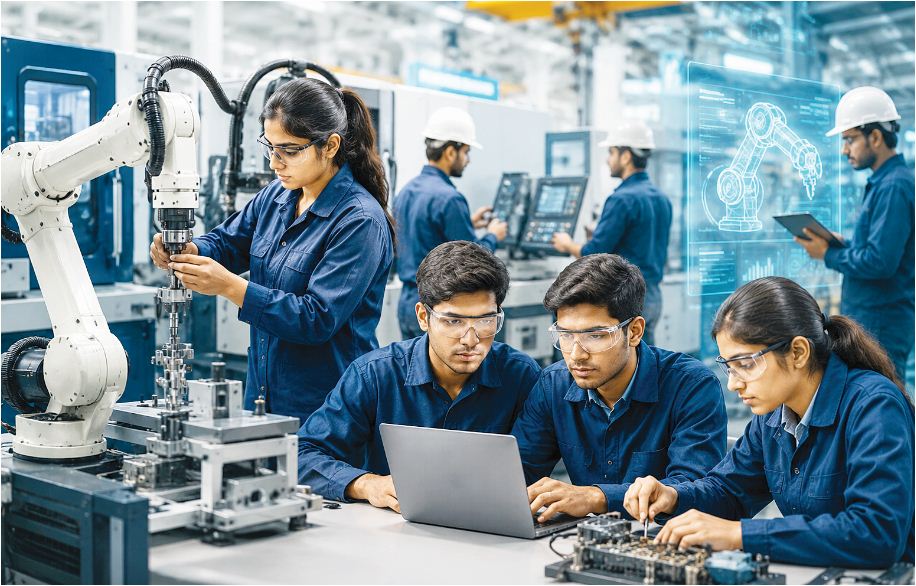
Jaipur | Charu Bhatia | India’s manufacturing sector is undergoing a significant transformation, driven by automation, advanced technologies and the government’s push to position the country as a global manufacturing hub. While investments in infrastructure, machinery and industrial expansion continue to rise, industry leaders are increasingly identifying one factor as the key to sustainable growth: a skilled workforce. As manufacturing processes become more sophisticated, traditional academic qualifications alone are no longer sufficient to meet industry demands. Companies are seeking workers equipped with practical, job-ready skills in areas such as robotics, automation, artificial intelligence, industrial maintenance, quality control and data analytics. This shift is placing skill-based education at the centre of India’s manufacturing growth story.
The demand for skilled talent is being accelerated by initiatives such as Make in India, Production Linked Incentive (PLI) schemes and the expansion of sectors including electronics, semiconductors, electric vehicles and renewable energy equipment. These industries require employees who can operate advanced machinery, manage digital production systems and adapt to rapidly changing technologies. Industry experts note that one of the biggest challenges facing manufacturers today is the widening gap between educational outcomes and workplace requirements. While millions of students graduate every year, many employers struggle to find candidates with the technical competencies needed for modern factory environments. As a result, businesses are increasingly partnering with educational institutions and training providers to develop industry-relevant curricula.
Vocational training centres, polytechnic institutes and skill development platforms are witnessing growing demand as companies prioritize practical expertise over theoretical knowledge. Apprenticeship programs are also gaining momentum, offering students hands-on experience while creating a pipeline of job-ready talent for employers.
Technology is further reshaping the skill development landscape. Online learning platforms, virtual simulations and AI-powered training modules are making technical education more accessible and scalable. Workers can now acquire specialized manufacturing skills through flexible learning models, helping industries address talent shortages more efficiently.
The economic implications are substantial. A workforce equipped with industry-specific skills can improve productivity, reduce operational errors and enhance global competitiveness. For businesses, this translates into higher efficiency and stronger growth potential. For workers, it creates better employment opportunities and career advancement prospects.
As India aims to increase the manufacturing sector’s contribution to the economy, skill-based education is emerging as a strategic necessity rather than an optional investment. The future of manufacturing growth will depend not only on factories and technology, but also on the availability of skilled professionals capable of driving innovation and operational excellence in an increasingly competitive global market.