

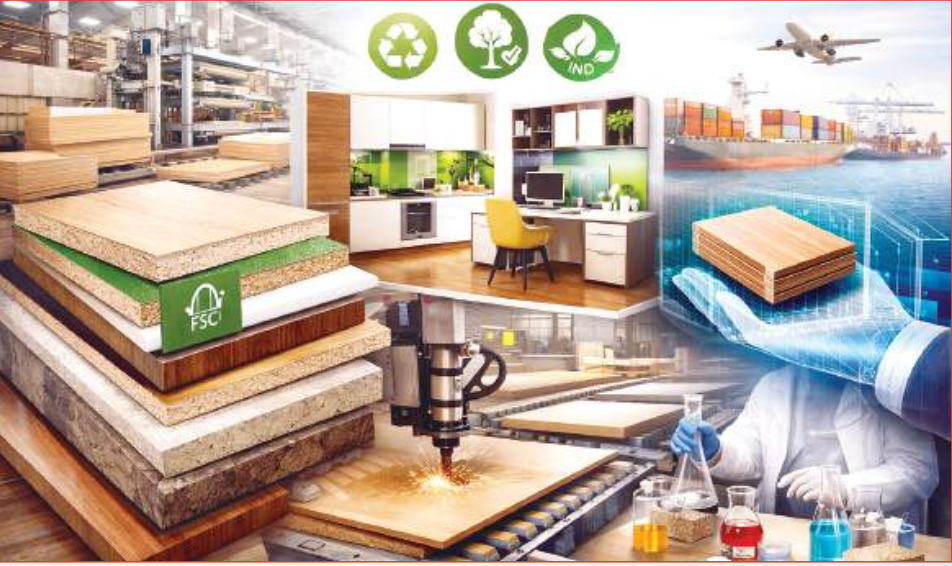
Charu Bhatia | Business Remedies | India’s fast-growing modular furniture market is quietly reshaping the country’s wood panel industry. As urban consumers prioritise space efficiency, customisation and quick installation, manufacturers of plywood, MDF, HDF and particle boards are being pushed to innovate faster than ever before. The rise of compact urban housing, hybrid work culture and aspirational middle-class spending has made modular kitchens, wardrobes and office systems mainstream rather than premium. This demand surge is directly influencing how wood panels are designed, processed and marketed.
Unlike traditional carpentry, modular furniture relies heavily on precision-engineered panels that are uniform, lightweight and durable. This has accelerated the shift from conventional plywood to engineered wood products such as medium-density fibreboard (MDF) and high-density fibreboard (HDF). These materials offer smoother finishes, better machinability and compatibility with automated production systems like CNC cutting and edge banding.
Industry players note that the need for consistency is key. Modular units are factory-produced, often in large volumes, leaving little room for variation in thickness, density or moisture content. As a result, panel manufacturers are investing in advanced pressing technology, calibrated boards and moisture-resistant variants tailored for kitchens and bathrooms. Another major trend is surface innovation. With consumers seeking premium aesthetics at competitive prices, laminated and pre-laminated boards are gaining traction. Anti-scratch, anti-bacterial and fire-retardant surfaces are increasingly becoming selling points rather than niche features. The push for seamless finishes has also led to the growing popularity of UV-coated and acrylic panels, especially in high-end modular kitchens.
Sustainability is emerging as an additional catalyst. As large real estate developers and organised furniture brands align with ESG goals, demand for FSC-certified panels and low-formaldehyde emission boards is rising. Manufacturers are responding with eco-friendly adhesives and improved emission standards to meet both domestic regulations and export requirements. The organised furniture retail boom, led by both global brands and homegrown direct-to-consumer players, has further intensified competition. These companies depend on reliable panel suppliers who can deliver consistent quality at scale. This dynamic is encouraging consolidation in the wood panel sector, with larger players expanding capacity and smaller units upgrading technology to stay relevant.
Exports are also benefiting. India’s ambition to strengthen its furniture exports hinges significantly on the availability of globally compliant engineered wood panels. Innovation in panel quality, design flexibility and durability is becoming critical to compete with established manufacturing hubs in Southeast Asia and Europe. Looking ahead, experts believe the next phase of growth will centre around lighter yet stronger composite panels, improved water resistance and digitally printed surfaces that mimic natural wood grains with higher realism. As modular living becomes the norm rather than the exception, the ripple effect on India’s wood panel industry is unmistakable. What was once considered a back-end raw material segment is now at the forefront of design, technology and sustainability transformation, proving that in the business of furniture, innovation often begins beneath the surface.