

Jaipur | Charu Bhatia
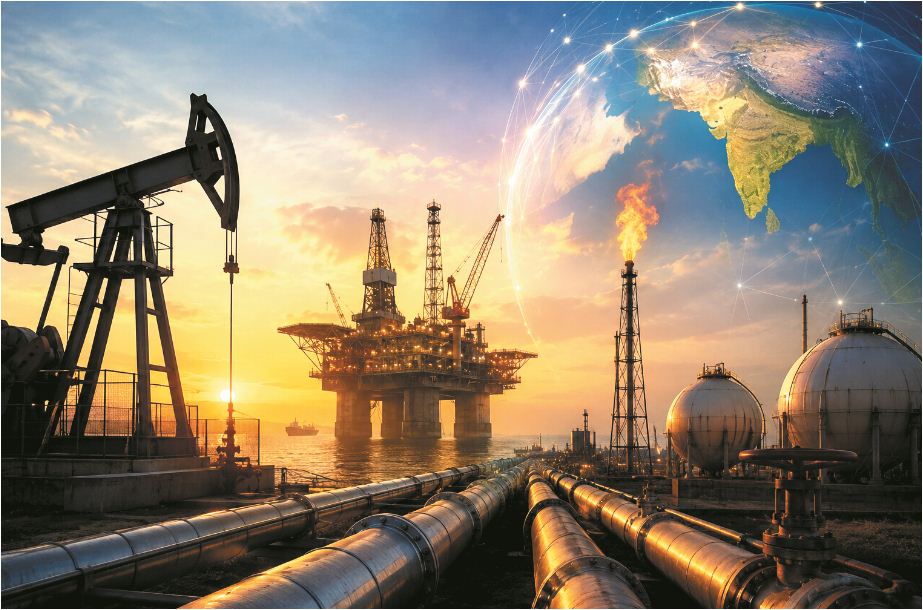
India’s economic growth is closely tied to its ability to secure reliable and affordable energy. With oil and gas continuing to play a crucial role in transportation, manufacturing, power generation and several industrial processes, strengthening domestic production has become an important part of the country’s broader energy security strategy.
India remains heavily dependent on imports to meet its crude oil requirements. This leaves the economy exposed to fluctuations in international crude prices, geopolitical tensions, shipping disruptions and changes in global energy markets. Greater domestic exploration and production can help reduce some of these vulnerabilities while creating opportunities for businesses across the energy value chain.
Reducing Exposure To
Global Oil Shocks
Crude oil prices can rise sharply when conflicts, supply disruptions or production cuts affect global markets. For an import-dependent economy, higher crude prices can increase the cost of transportation and manufacturing while putting pressure on inflation and the trade balance. Expanding domestic oil and gas production can provide a degree of insulation against such external shocks. Although domestic output alone cannot eliminate import dependence, every additional unit produced within the country can reduce the requirement for overseas supplies.
For businesses, greater energy stability can make fuel and input costs easier to manage, particularly for industries that depend heavily on petroleum products.
Investment Opportunities Across The Energy Chain
Boosting domestic production is not simply about extracting more hydrocarbons. It can generate demand for investment across exploration, drilling, oilfield services, pipelines, storage, refining and associated infrastructure. Technological improvements are also becoming increasingly important as companies explore more complex geological formations and mature fields. Advanced exploration techniques, improved recovery technologies, data analytics and automation can potentially help increase output from existing assets while making new projects more commercially viable.
This creates opportunities not only for large energy companies but also for engineering, technology, equipment and specialised service providers.
Gas Can Support The Energy Transition
Natural gas has another important role in India’s energy strategy. It can support industries seeking to reduce their dependence on more carbon-intensive fuels while renewable energy capacity expands.
Greater domestic gas production could strengthen supplies for sectors such as fertilisers, city gas distribution, power and manufacturing. A stronger domestic gas ecosystem can also reduce exposure to international LNG price movements.
Balancing Energy Security With Sustainability
India’s energy strategy is increasingly shaped by two priorities: meeting present energy demand while preparing for a lower-carbon future. Domestic oil and gas production therefore needs to develop alongside renewable energy, electric mobility, biofuels, green hydrogen and energy-efficiency initiatives.
The objective is not simply to produce more hydrocarbons, but to build a more resilient and diversified energy system. For India’s business landscape, domestic oil and gas production can consequently serve as more than an energy policy objective. It can support investment, strengthen supply-chain resilience and reduce exposure to global energy volatility, while giving the economy greater flexibility during its long-term transition towards cleaner energy.