

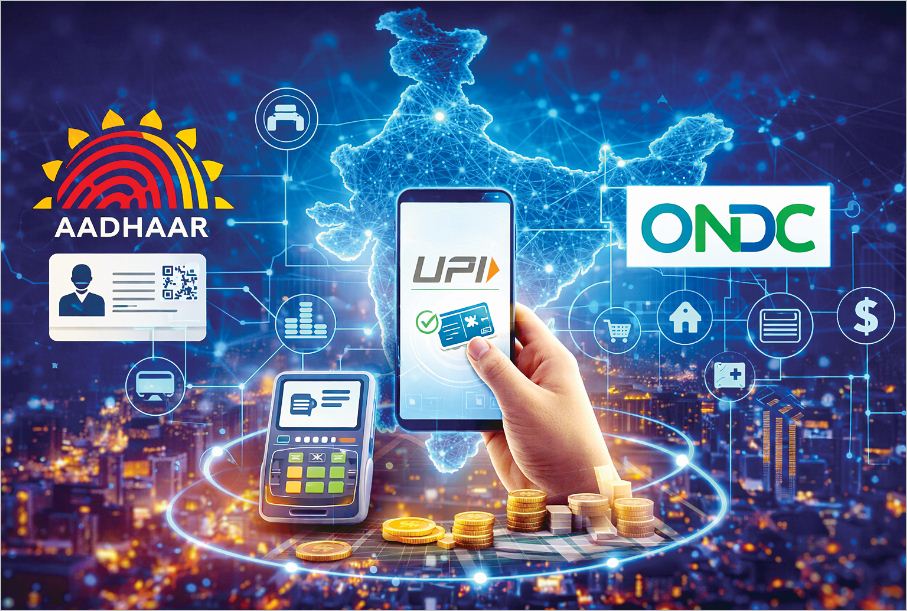
Charu Bhatia | Business Remedies | India’s digital transformation is entering a new phase, driven by the evolution of what is widely known as India Stack. Built on the foundations of Aadhaar, UPI, and a growing layer of open digital networks like ONDC, this ecosystem is redefining how businesses operate, scale, and compete in one of the world’s fastest-growing digital economies.
The first phase of India Stack focused on identity, payments, and basic financial inclusion. Aadhaar enabled a universal digital identity, while UPI revolutionised real-time payments, making transactions seamless, low-cost, and accessible to millions. Together, they laid the groundwork for a formal, digitally connected economy.
Now, India Stack 2.0 is expanding beyond these core pillars to create an interoperable, open-access digital infrastructure for multiple sectors. At the heart of this shift is ONDC (Open Network for Digital Commerce), which aims to decentralise e-commerce by breaking the dominance of platform-centric models. Instead of a few large marketplaces controlling buyer-seller interactions, ONDC allows businesses of all sizes to participate in a network where discovery, logistics, and payments are unbundled.
For businesses, this marks a structural shift. Small retailers and kirana stores can now access digital commerce without being locked into high-commission platforms. Startups, meanwhile, can build specialised solutions, whether in logistics, inventory, or customer engagement, on top of this open network, lowering entry barriers and fostering innovation.
Another critical layer in India Stack 2.0 is the emergence of data-sharing frameworks like Account Aggregators, which enable secure and consent-based financial data exchange. This is transforming lending, especially for MSMEs, by allowing lenders to assess creditworthiness using real-time data rather than traditional collateral-heavy models.
The implications for the business landscape are significant. Digital public infrastructure is no longer just an enabler, it is becoming the backbone of economic activity. From fintech and e-commerce to healthcare and mobility, sectors are being reshaped by interoperable systems that prioritise access, efficiency, and scale.
However, challenges remain. Ensuring data privacy, maintaining cybersecurity, and achieving widespread adoption across smaller businesses will be critical to sustaining momentum. There is also the question of monetisation, as open networks must balance accessibility with viable business models for participants.
Despite these hurdles, India Stack 2.0 represents a powerful shift in how digital economies can be built, public infrastructure enabling private innovation at scale. As this ecosystem matures, it has the potential not only to deepen India’s digital economy but also to serve as a global blueprint for inclusive and interoperable growth.