


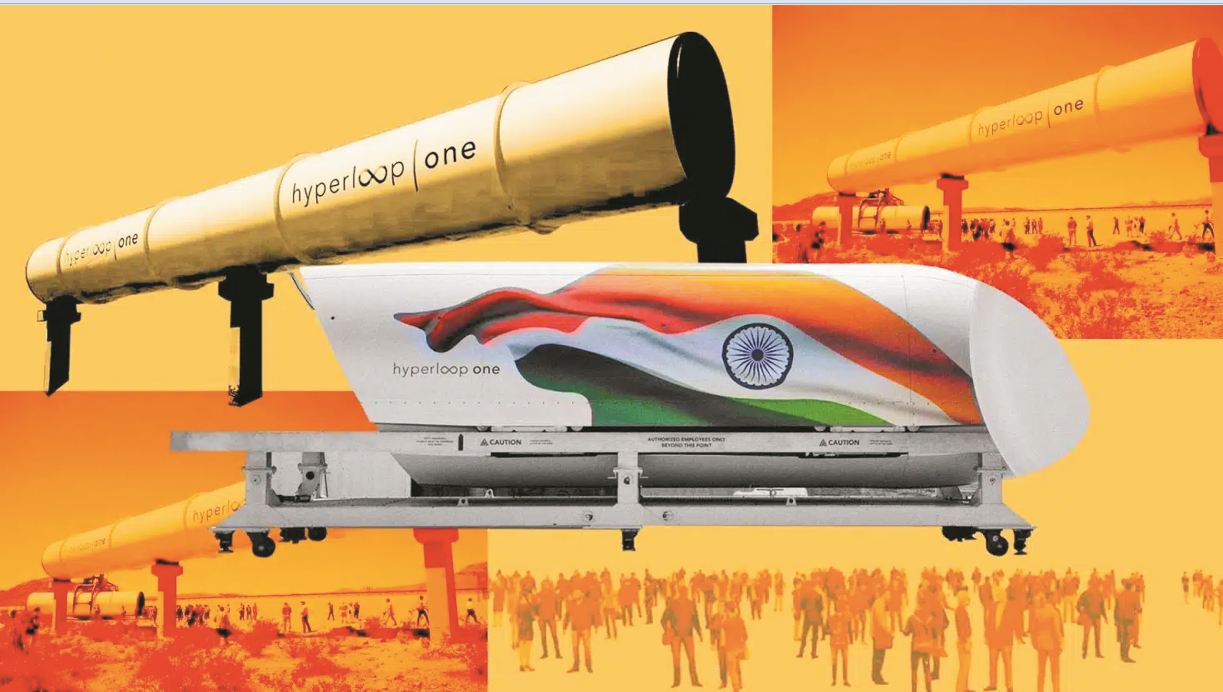
Shruti Kothari | Jaipur, February 28 | IT Madras, in collaboration with the Ministry of Railways, has taken a groundbreaking step towards transforming India’s transportation landscape by developing the country’s first ‘hyperloop test track’. This ambitious project marks India’s entry into the race for ultra-high-speed transportation and positions the nation as a potential leader in futuristic mobility solutions.
What is the Hyperloop Project?
Hyperloop is an advanced mode of transportation that uses vacuum tubes to propel passenger pods at near-supersonic speeds with minimal friction. Originally conceptualized by Elon Musk, the technology has gained global traction, with countries like the US, UAE, and China exploring its feasibility. The ‘hyperloop’ system has the potential to revolutionize travel, drastically reducing commute times and enhancing energy efficiency.
The hyperloop test track at IIT Madras aims to serve as a research and development hub for this technology, enabling engineers, scientists, and startups to test and refine their innovations. By providing a controlled environment for experimentation, the project will accelerate the development of indigenous hyperloop technology, reducing India’s dependence on foreign expertise and infrastructure.
Why is This Significant for India?
1. Revolutionizing Transportation: If successfully implemented, hyperloop technology could reduce travel time between major cities to mere minutes, significantly enhancing connectivity and economic growth.
2. Sustainability and Energy Efficiency: Unlike conventional rail and air transport, hyperloop operates on renewable energy and has minimal carbon emissions, aligning with India’s commitment to sustainable development.
3. Boosting Innovation and Economy: The project places India on the global map of next-generation transport development, attracting investments and creating opportunities for startups and industries in the mobility sector.
4. Strengthening Indigenous Capabilities: With IIT Madras leading research and development, India has the chance to pioneer homegrown hyperloop solutions rather than relying on foreign technology.
The Road Ahead
While the potential of hyperloop is immense, challenges remain. Infrastructure development, regulatory approvals, and high initial costs could pose hurdles to large-scale implementation. However, with government backing and institutional support, India is well-positioned to address these challenges and make hyperloop transportation a reality.
As IIT Madras pioneers this ambitious initiative, the big question remains-can India successfully commercialize hyperloop technology and integrate it into its transport ecosystem? If so, this could mark the beginning of a new era in India’s mobility landscape, redefining how the country travels in the decades to come.