
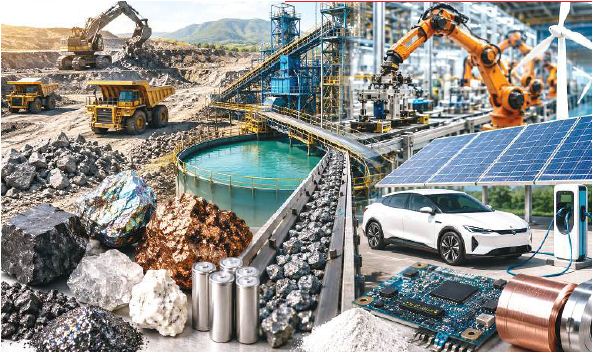
Jaipur | Charu Bhatia | India’s mineral industry is undergoing a significant transformation. Traditionally focused on the extraction and export of raw minerals, the sector is now increasingly moving towards value addition, processing, and manufacturing. This shift is expected to strengthen domestic industries, reduce import dependence, create employment opportunities, and enhance India’s position in global supply chains.
The growing demand for critical minerals such as lithium, cobalt, graphite, nickel, and rare earth elements has highlighted the importance of building a robust mineral value chain within the country. These minerals are essential for electric vehicles (EVs), renewable energy systems, electronics, semiconductors, and advanced manufacturing. While access to mineral resources remains important, industry experts believe that the real economic value lies in processing, refining, and converting raw materials into finished or semi-finished products.
Government initiatives are playing a crucial role in accelerating this transition. Reforms in mining regulations, increased private sector participation, and efforts to secure critical mineral resources both domestically and internationally are encouraging investment across the mineral ecosystem. Policies aimed at boosting manufacturing under initiatives such as Make in India are also creating demand for locally processed mineral products. The country’s push towards clean energy and electric mobility is further driving the need for value-added mineral industries. Battery manufacturing, solar panel production, and electronics assembly require a steady supply of processed minerals and refined materials. As India seeks to become a global manufacturing hub, domestic mineral processing capabilities are expected to become increasingly important.
Technology is also emerging as a key enabler of this transformation. Advanced beneficiation techniques, automation, artificial intelligence, and digital monitoring systems are helping improve efficiency, reduce waste, and increase the quality of mineral outputs. These innovations are allowing companies to extract greater value from available resources while enhancing sustainability. Environmental, social, and governance (ESG) considerations are shaping the future of the sector as well. Investors and consumers are placing greater emphasis on responsible sourcing, environmental protection, and sustainable mining practices. Companies that integrate sustainability with value-added production are likely to gain a competitive advantage in both domestic and international markets.
Industry observers believe that the next phase of growth for India’s mineral sector will depend not only on discovering and extracting resources but also on developing integrated value chains that connect mining with manufacturing. By moving beyond the export of raw materials and investing in refining, processing, and advanced manufacturing, India can capture a larger share of the economic benefits generated by its mineral resources. As global demand for critical minerals continues to rise, value addition is set to become the defining trend shaping the future of India’s mineral industry.