

Jaipur | BR Team
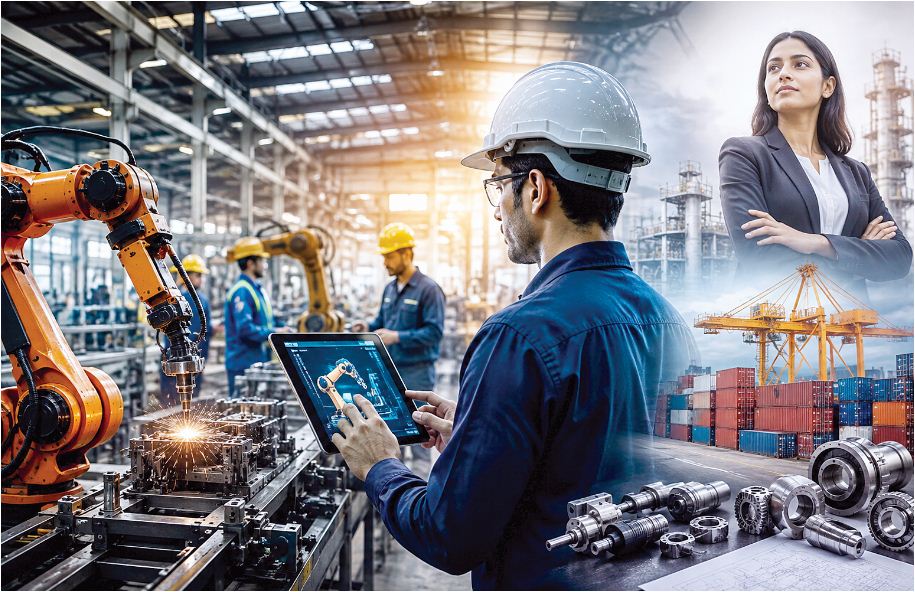
India’s push to strengthen domestic manufacturing is creating a growing set of opportunities for entrepreneurs beyond traditional factory businesses. As companies look to build local supply chains, reduce dependence on imports and participate in global production networks, startups and small businesses are finding opportunities across manufacturing, components, technology, logistics and industrial services.
For emerging entrepreneurs, the opportunity is not necessarily about building a large manufacturing plant from day one. Smaller businesses can enter the ecosystem by solving specific problems for manufacturers, supplying specialised components or providing technology that makes production faster and more efficient.
The Opportunity Beyond Large Factories
India’s manufacturing ecosystem requires much more than finished products. Every major manufacturing unit depends on a network of suppliers providing components, packaging, machinery, maintenance, quality testing, software and logistics.
This creates room for entrepreneurs to build specialised businesses serving larger manufacturers. A founder with expertise in engineering, materials, electronics or software, for instance, can focus on a niche component or industrial solution rather than competing directly with established manufacturers.
The growth of contract manufacturing and outsourcing is also creating opportunities for smaller companies to become suppliers to larger brands. Entrepreneurs who can consistently meet quality, cost and delivery requirements can potentially build long-term B2B relationships.
Technology Is Changing The Factory Floor
Manufacturing is increasingly becoming a technology-driven business. Automation, robotics, artificial intelligence, Internet of Things systems and data analytics are being used to improve productivity, monitor machinery and reduce operational inefficiencies.
This opens opportunities for technology entrepreneurs to develop affordable solutions specifically for small and medium-sized manufacturers. Instead of selling expensive systems designed for large corporations, startups can focus on simpler tools for inventory management, predictive maintenance, quality control and production monitoring. For founders, this creates an important opportunity at the intersection of manufacturing and technology.
Local Supply Chains Can Create New Businesses
As businesses strengthen domestic supply chains, demand can rise for locally produced components and specialised industrial products. Entrepreneurs can identify products that manufacturers currently source from distant suppliers or import and explore whether they can build competitive domestic alternatives.
However, entering manufacturing requires more than identifying a market gap. Founders need to understand production costs, quality standards, working capital requirements, regulatory compliance and the reliability of raw-material supplies.
Tier-2 And Tier-3 CitiesCould Benefit
Manufacturing growth is also creating opportunities outside India’s biggest metropolitan centres. Smaller cities can offer lower operating costs, access to industrial clusters and a growing pool of skilled workers.
For entrepreneurs, setting up businesses closer to existing industrial ecosystems can create advantages in sourcing, hiring and customer access. Local manufacturing networks can also generate opportunities for ancillary businesses, from packaging and transportation to equipment maintenance.
What Founders Should Focus On
The manufacturing opportunity is ultimately about solving real business problems. Entrepreneurs should identify areas where manufacturers face persistent challenges, such as high input costs, inefficient processes, quality issues, supply-chain delays or shortage of specialised suppliers.
The biggest opportunity may therefore not lie in building the next large factory, but in becoming an essential part of the factories India is building.
As domestic production expands, founders who combine industry knowledge with technology, cost efficiency and reliable execution could find themselves well placed to participate in India’s next manufacturing cycle.