

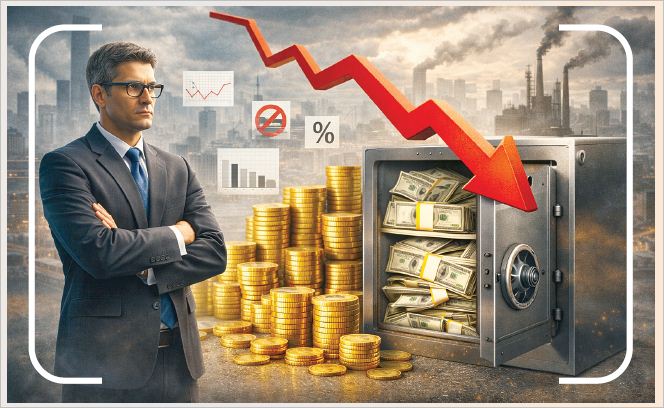
Charu Bhatia | Business Remedies | For years, corporate success was measured by expansion, new markets, aggressive hiring, ambitious acquisitions and relentless growth. In 2026, that playbook is being quietly rewritten. Across sectors, companies are shifting focus from chasing scale to protecting liquidity, making cash conservation the new mantra in boardrooms.
This change is being driven by a convergence of economic uncertainty, higher borrowing costs and unpredictable global conditions. With interest rates remaining elevated and capital no longer cheap, cash has regained its status as a strategic asset rather than idle balance-sheet comfort.
From Growth At Any Cost To Financial Discipline
During years of easy liquidity, companies prioritised growth, often funded by low-cost debt or abundant investor capital. Today, that environment has changed. Rising interest rates have increased the cost of borrowing, while global disruptions, from geopolitical tensions to supply-chain volatility, have made long-term forecasting more complex.
As a result, businesses are re-examining capital allocation decisions. Expansion plans are being staggered, discretionary spending is under scrutiny and non-core investments are being deferred. Preserving cash now offers companies the flexibility to absorb shocks without compromising core operations.
Liquidity As A Competitive Advantage
Cash conservation is no longer about caution alone, it is about competitiveness. Companies with strong cash reserves are better positioned to negotiate supplier contracts, manage working capital and respond swiftly to market shifts. They also gain leverage in uncertain times, whether through opportunistic acquisitions or strategic investments when valuations soften. In contrast, firms with stretched balance sheets face limited options. Tight liquidity reduces their ability to innovate, retain talent or navigate prolonged slowdowns. This gap is making financial resilience a defining factor in corporate performance.
A Strategic Reset In Corporate Spending
Across industries, cost structures are being reworked. Businesses are renegotiating leases, optimising inventory cycles and adopting asset-light models. Hiring is becoming more targeted, with productivity and role efficiency taking precedence over headcount growth. Even marketing and technology spends are being measured against clearer return-on-investment metrics. Importantly, this shift is not about across-the-board cuts. Instead, companies are prioritising spending that directly supports revenue stability and long-term value creation while trimming areas that offer limited strategic payoff.
Investors Are Rewarding Prudence
Market sentiment is also reinforcing this shift. Investors are increasingly favouring companies that demonstrate disciplined cash management, healthy free cash flows and transparent capital-allocation strategies. Profitability, once secondary to growth narratives, is firmly back in focus.
This change is particularly visible in the startup ecosystem, where burn rates are under intense scrutiny. Founders are being encouraged to extend runways, build sustainable revenue streams and reduce dependence on external funding.
Preparing For An Uncertain Future
Cash conservation ultimately reflects a broader mindset change, one that values preparedness over optimism. With global economic cycles becoming shorter and more volatile, companies are acknowledging that resilience is as important as ambition.
In this environment, holding cash is not a sign of hesitation but of strategic clarity. Businesses that balance growth aspirations with financial discipline are better equipped to weather uncertainty and seize opportunities when conditions improve.
As 2026 unfolds, one thing is clear: in a world where uncertainty is the only constant, cash is no longer just king, it is corporate survival capital.