Charu Bhatia |Business Remedies | India’s push towards a more formal economy has been one of the most significant structural shifts of the past decade. From GST and digital payments to Aadhaar-linked benefits and tighter tax compliance, formalisation is often presented as a necessary step towards transparency, efficiency, and sustainable growth. Yet, while the move brings clear gains for some, it also creates friction and challenges for others, especially at the margins of the economy.
At its core, formalisation refers to bringing businesses, workers, and transactions into the regulated system. This includes tax registration, documented employment, digital payments, and compliance with labour and financial laws. For the government, the benefits are obvious. A wider tax base improves revenue collection, reduces leakages, and enables better policy targeting. Digital trails make it easier to track economic activity, curb black money, and design welfare schemes with fewer intermediaries.
Large corporations and organised businesses are among the biggest gainers. Formalisation levels the playing field by reducing unfair competition from tax-evading informal players. Access to formal credit improves as documented revenues and balance sheets make it easier to borrow from banks and financial institutions. Over time, this also helps firms scale up, attract investment, and integrate into global supply chains.
Consumers, too, benefit in subtle ways. Formalisation improves product quality, accountability, and grievance redressal. Digital payments, e-invoicing, and standardised taxation have increased convenience and reduced ambiguity in pricing. Workers in the formal sector gain from social security benefits such as provident funds, insurance, and regulated working conditions, at least in principle.
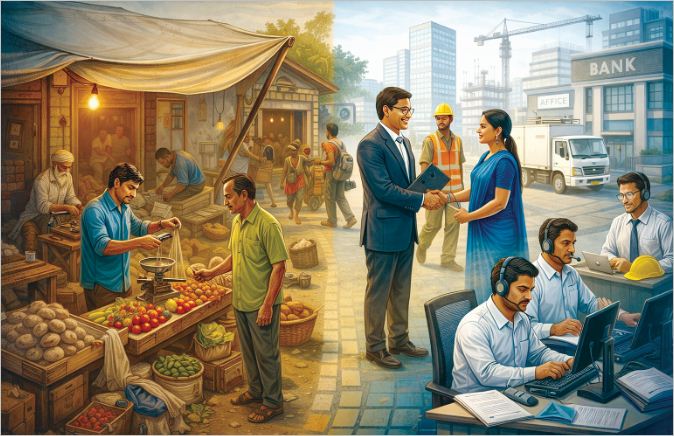
However, the transition is far from painless. India’s informal sector employs a large majority of the workforce, particularly in small manufacturing units, retail trade, construction, and services. For micro and small enterprises, compliance costs, ranging from GST filings to digital accounting, can be overwhelming. Many lack the financial literacy, infrastructure, or cash buffers needed to adapt quickly. As a result, some businesses downsize, shut operations, or remain trapped in partial informality.
Workers in the informal economy often face the sharpest risks. Increased compliance can lead employers to cut jobs or shift to contractual arrangements to avoid costs. While formalisation promises long-term security, the short-term reality can be income instability and job loss, especially for migrant and low-skilled workers.
The challenge, therefore, lies in managing the pace and design of formalisation. Without adequate handholding, such as simplified compliance, easier access to credit, and skill support, the process risks widening inequalities rather than reducing them.
Formalisation is neither inherently good nor bad; its impact depends on how inclusive it is. If supported by policy sensitivity and ground-level capacity building, it can drive cleaner growth. If rushed or uneven, it risks leaving behind the very segments it aims to uplift.